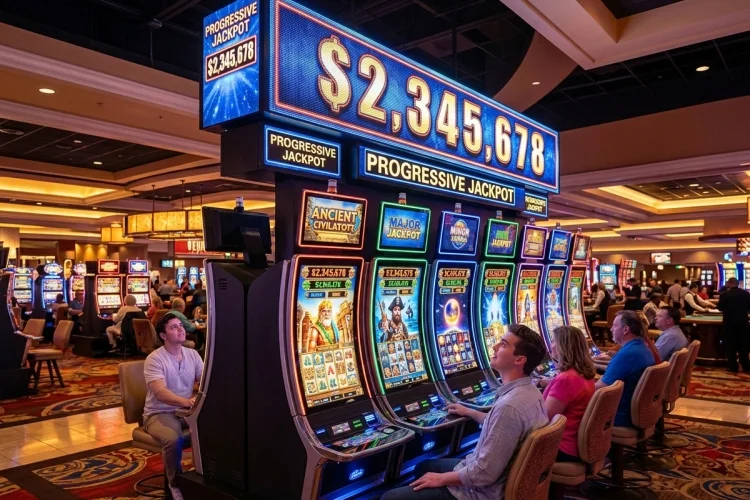
A standard slot usually offers prizes with values defined in its paytable. A progressive slot adds something different: a jackpot whose displayed value can increase over time until an eligible player wins it.
This growing prize is what makes progressive jackpot slots easy to recognize. Their jackpot meters may show amounts far larger than the maximum prizes offered by ordinary slot games.
However, the eye-catching total tells only part of the story. Players must also understand how the prize is funded, which bets qualify, what triggers the jackpot, and how the amount resets after a win.
These details can vary significantly between games. Progressive jackpots are generally associated with infrequent, potentially large awards and high volatility.
They should therefore be treated as entertainment rather than a reliable opportunity to make money. Knowing how the system works will not predict the next winner, but it can help players understand the risks, rules, and true cost of participation.
What Is a Progressive Jackpot Slot?
A progressive jackpot slot is a game connected to a prize pool whose value can increase as qualifying wagers are made.
A configured portion of eligible play may contribute to the growing amount, depending on the game’s mathematical design.
The jackpot normally begins at a predetermined starting or reset value. It rises until the required event occurs, after which the prize is awarded and the meter returns to its stated reset amount.
Regulated-game rules should explain how the jackpot is funded, its starting value, any maximum ceiling, and what happens after a payout. The current meter should also be updated as frequently as practical.
How Does the Jackpot Increase?
Suppose a jackpot begins at $100,000. As eligible players place wagers, the system may direct part of the mathematical return toward the progressive pool.
The amount added from one spin may be extremely small. However, thousands of qualifying wagers across a connected network can cause the meter to rise steadily.
Not every contribution necessarily appears directly on the visible meter. Some systems may use reserve or diversion pools to help fund the next reset value, cover simultaneous wins, or manage jackpot overflow.
Applicable rules should explain how contributions are treated when a jackpot reaches a ceiling.
The Main Types of Progressive Jackpots
1. Standalone Progressives
A standalone jackpot is connected to one game or gaming device. Because it receives activity from a limited source, its meter may grow more slowly than a large networked prize.
2. Local or Linked Progressives
A linked jackpot combines qualifying play from several games within one casino, website, or controlled group. Multiple titles may share the same prize pool.
3. Wide-Area Progressives
A wide-area progressive connects games across multiple participating venues or platforms. GLI defines a multi-site or wide-area progressive as a linked jackpot interconnected between multiple gaming venues
IGT’s wide-area portfolio provides a commercial example of games connected to major shared prizes.
How Can a Progressive Jackpot Be Triggered?
The winning mechanism depends entirely on the rules. Some games require a specific symbol combination, while others award access through a bonus wheel, pick feature, or special jackpot round.
A mystery jackpot works differently. It may be triggered randomly during an eligible play or when the meter reaches a hidden threshold selected by the system.
Gaming Laboratories International states that mystery-triggered jackpots can use random events or randomly selected hidden trigger thresholds.
The RNG and each relevant implementation should be evaluated according to applicable regulatory requirements.
Players should never assume that a full reel of jackpot symbols is required. The game’s help page is the only reliable source for its trigger conditions.
Do You Need to Place the Maximum Bet?
Some progressive slots make the jackpot available at every stake. Others require a minimum wager, particular coin setting, selected side bet, or specific number of active lines.
For example, IGT describes certain mystery progressives as awarding jackpots randomly on qualifying games, with optional required minimum bets applying to particular prize levels.
This illustrates why eligibility must be checked game by game. Increasing the wager should not be assumed to guarantee eligibility or substantially improve the chance of winning.
Regulations in Great Britain state that where players contribute to a pool, eligibility and winning chances should relate fairly to the contribution.
Progressive Jackpots, RTP, and Volatility
RTP is the theoretical percentage of stakes a game is designed to return over extensive play. A progressive slot may display one combined RTP or separate percentages for the base game and jackpot component.
UK technical standards require the available jackpot rules to explain the RTP presentation. They must also identify when a player is ineligible for the progressive award and show the relevant theoretical return.
Progressive jackpots tend to be infrequent and large, giving them high-volatility characteristics. The UK Gambling Commission therefore recommends monitoring the base game and jackpot component separately in certain performance assessments.
A high jackpot meter does not mean a payout is “due.” Random games do not become more likely to award a prize simply because the previous spins lost.
What Happens After Someone Wins?
Once a valid jackpot is triggered, the operator or system verifies the result and awards the stated prize according to the rules. The meter then usually resets to its seed or reset value.
The rules should explain how simultaneous or apparently simultaneous claims are handled, including situations affected by network latency. Eligible players should also be notified when the jackpot has been won and reset.
Payment procedures may depend on the operator, provider, prize size, and jurisdiction. Players should read the payout conditions instead of assuming every jackpot is handled in the same way.
Progressive jackpot slots feature prizes that increase from a starting value until an eligible player triggers the award. They may operate as standalone games, local linked systems, wide-area networks, or multi-level jackpots with several prize tiers.
The growing meter is only one factor to examine. Players should also check the trigger mechanism, minimum qualifying wager, RTP, volatility, reset value, and payment conditions.
Before spinning, open the official paytable and confirm that your chosen stake is eligible. Set a strict entertainment budget and never raise a wager because the jackpot appears close to being won.
Progressive prizes can be large, but the outcome remains uncertain and the entire stake can be lost.