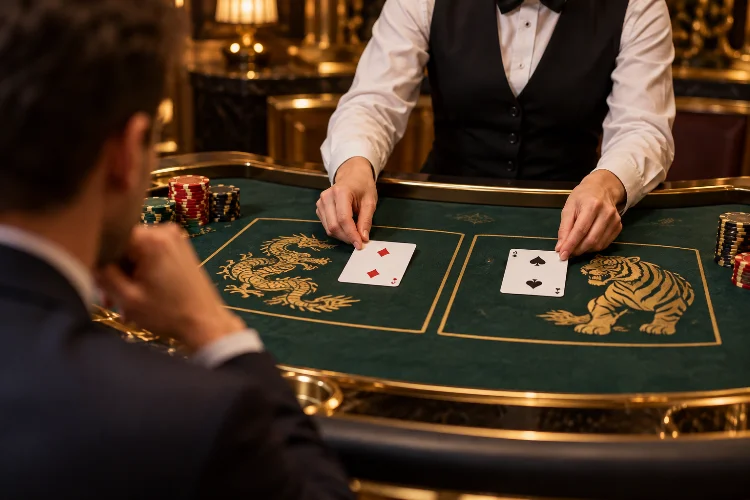
Dragon Tiger is often compared with baccarat, but it strips the idea down to the bare minimum. There are only two competing positions, each receives a single card, and the higher rank wins. That makes the game extremely easy to watch.
The interesting part of the Dragon Tiger Rules appears when you look more closely at ties, side bets, payout variations, and house edge.
Those details explain why two wagers that seem similar can have very different mathematical costs. This beginner-friendly guide explores those numbers without turning the game into a complicated statistics lesson.
Why Dragon Tiger Is Simpler Than Baccarat
Dragon Tiger and baccarat share a similar visual structure.
Both have two competing sides and allow players to wager before cards are dealt. However, baccarat can require multiple cards and scoring rules based on totals.
Dragon Tiger eliminates almost all of that.
One card is dealt to Dragon. One goes to Tiger. The higher-ranked card wins.
Pragmatic Play describes the game as a two-card version of baccarat, while Evolution uses the same straightforward higher-card concept.
There is no decision to hit, stand, draw, or fold.
That simplicity makes Dragon Tiger accessible, but it does not mean every betting option is equally favourable.
Understanding the payout structure is still important.
Main Dragon and Tiger Bets Pay Even Money
The most obvious choices are Dragon and Tiger.
Choose Dragon if you expect its card to rank higher. Choose Tiger if you think Tiger will receive the higher card.
Standard versions pay even money on a winning main bet.
Imagine wagering $20 on Tiger.
Tiger receives a 10 and Dragon receives a 4. Tiger wins, so the $20 wager earns $20 in profit and the initial stake is also returned.
The rules analysed by Wizard of Odds use eight decks and rank Ace as the lowest card and King as the highest. Under that structure, each Dragon and Tiger side has roughly a 46.27% probability of winning, with ties accounting for the remaining outcomes.
That tie probability is what prevents the wager from being a simple 50/50 proposition.
The Tie Rule Creates the Main House Advantage
Suppose both cards are Jacks.
Neither Dragon nor Tiger has a higher rank.
In the common format, a main wager on Dragon or Tiger loses half when this happens. This means a $20 wager would return $10 rather than the full $20.
With eight decks and this half-loss tie rule, Wizard of Odds calculates a house edge of approximately 3.73% on either Dragon or Tiger.
This is an important comparision point.
Players sometimes assume an even-money payout means the wager has almost no built-in casino advantage.
The tie treatment changes that.
A 1:1 winning payout can still coexist with a meaningful house edge when one result causes part of the wager to be lost.
Tie Bets Have Bigger Payouts but Higher Risk
The Tie wager looks more exciting because its payout is much larger.
Evolution’s standard Dragon Tiger presentation lists Tie at 11:1.
However, a bigger payout does not necessarily mean stronger mathematical value.
Using an eight-deck game and an 11:1 Tie payout, Wizard of Odds calculates a house edge of approximately 10.36%. If the Tie pays only 10:1, the calculated edge rises to about 17.83%. At an 8:1 payout, it becomes roughly 32.77%.
Those figures show why checking the payout is so important.
The actual event – the two cards matching in rank – may be identical across tables, but changing the payout can dramatically alter the wager’s expected return.
Suited Tie Is Even More Specific
A Suited Tie requires more than matching ranks.
The two cards must be identical in both rank and suit.
Suppose Dragon receives the 8 of spades.
If Tiger receives another 8 of hearts, that is an ordinary Tie but not a Suited Tie. To qualify for the suited version, Tiger must also receive an 8 of spades from another deck in the shoe.
Evolution lists a 50:1 payout for its standard Suited Tie wager.
With an eight-deck shoe and that payout, Wizard of Odds calculates a house edge of approximately 13.98%.
The large headline multiplier may look impressive, but the event occurs much less frequently than an ordinary Dragon or Tiger win.
Deck Count Can Change the Mathematics
Not every Dragon Tiger table uses exactly the same number of decks.
Wizard of Odds notes that Pragmatic Play and SA Gaming use eight decks in the versions it analyses, while Deltin specifies a shoe containing six to eight pre-shuffled decks.
The number of decks influences the exact probablity of ties because cards are being removed from a finite shoe.
That can slightly change the house edge.
However, beginners do not need to calculate card combinations manually before every session.
The practical lesson is simply to check the rules.
If two games use different numbers of decks or Tie payouts, they may look almost identical on screen while having slightly different mathematical characteristics.
Side Bets Can Work Differently Between Providers
Modern Dragon Tiger games often add extra betting areas.
Common examples include Big, Small, Odd, Even, Red, Black, Tie, and Suited Tie.
But the details are not always universal.
Wizard of Odds documents provider variations in how Odd/Even and other side wagers are defined and paid. Pragmatic Play, for example, uses a different structure from SA Gaming for certain side bets.
That is why it is risky to assume a wager named “Odd” works identically everywhere.
The payout may differ. The treatment of specific ranks can also differ.
A side bet should be treated as its own wager with its own rules and probability rather than as a decorative extension of the main Dragon-versus-Tiger game.
Why Dragon and Tiger Usually Beat the Side Bets Mathematically
For someone simply comparing the available wagers, house edge provides useful context.
Under the common eight-deck structure analysed by Wizard of Odds, Dragon and Tiger each carry an edge of about 3.73%.
That is lower than the 10.36% calculated for an 11:1 Tie and the 13.98% figure for a 50:1 Suited Tie. Some other side wagers can also carry higher mathematical costs.
This does not mean a main Dragon bet is guaranteed to win more often during one short session.
House edge is a long-run expectation.
A Tie can still appear on the very first round, while a sequence of Dragon or Tiger wagers can easily lose.
The figures are useful for comparing betting structures, not predicting the next card.
Live Dealer Variants Can Change the Presentation
The basic game has inspired several modern variations.
Evolution offers Super Speed Dragon Tiger, which shortens betting time and dealing procedures while retaining the basic high-card comparison.
It also offers Lightning Dragon Tiger, which adds multiplier mechanics and a fee structure to the familiar base game.
This illustrates an important point.
Knowing traditional Dragon Tiger does not mean every table is mechanically identical.
A standard live table, speed version, and multiplier-based version can share the same card-ranking idea while using very different payment structures.
Always check the rules panel before placing a wager rather than assuming the title tells you everything you need to know.
Recent Results Do Not Change the Next Card
Live Dragon Tiger screens often display recent results.
You might see a long sequence such as Dragon, Dragon, Tiger, Dragon, Dragon.
It is tempting to interpret that history as a pattern.
But a recent winning streak does not automatically make the opposite side “due.” The next card depends on the remaining shoe and the dealing process, not a need for the scoreboard to balance itself neatly.
Historical data describes previous rounds.
It does not provide a guaranteed prediction of the next one.
This is particulary important in a fast game because repeated results can look more meaningful than they really are.
Use the history display as information about what happened, not a signal telling you what must happen next.
Fast Rounds Can Increase Total Betting
Dragon Tiger’s simplicity also creates speed.
There are no strategy decisions after betting closes, so rounds can finish rapidly.
Speed versions make this even more obvious.
A faster table does not necessarily increase the house edge on a single unchanged wager, but it can allow many more wagers to be placed within an hour.
That means session cost can rise simply because betting opportunities arrive more frequently.
For a beginner, this may be more relevent than learning complicated betting systems.
Decide how much you are comfortable treating as entertainment before the session begins, and avoid increasing stakes purely because a previous round lost.
Simple rules do not make casino outcomes predictable.
The basic Dragon Tiger Rules are easy: one card goes to each side, Ace ranks lowest, King ranks highest, and the higher card wins. The real differences appear in Tie treatment, side-bet payouts, deck count, and modern game variants.
Before choosing a table, compare those details carefully. Understanding the payout rules and house edge gives you far more useful information than trying to predict patterns from recent cards.