Casino Guides

Maximising Value From Every Betting Session With Smarter Casino Play

A good casino session is not necessarily the one with the biggest short-term win. A player can finish ahead after making expensive decisions, while another can lose despite consistently choosing lower-cost wagers.

That distinction matters when Maximising Value From Every Betting Session becomes the objective. Instead of measuring success only by the final balance, advanced players can examine expected cost, game volatility, total turnover, bet sizing, and adherence to predetermined limits. This approach does not predict random outcomes. It creates a clearer framework for deciding how much risk is worth taking for the entertainment and playing time you want.

Define What “Value” Actually Means

Value in casino play should not be confused with guaranteed profitability.

Most casino games are designed with a mathematical return that favours the operator over sufficiently large amounts of play.

The Gambling Commission explains that RTP represents an average over a significant number of games rather than the result that must occur during any one person’s session.

Think in Cost per Session

Suppose your preferred game has a hypothetical 1.5% theoretical disadvantage.

At $1,000 in wagering turnover, the expected mathematical cost is around $15.

At $10,000, it becomes approximately $150.

Actual results can deviate substantially from those numbers.

The useful point is that value depends on how much money you repeatedly expose to the edge, not just whether the first few wagers happen to win.

Build a Game-Selection Hierarchy

Before worrying about bankroll tactics, rank the games available.

Check their published rules, RTP, payouts, or probability information.

UK technical standards aim to make relevant information available so customers can understand how a game works and make informed gambling decisions.

Compare Like With Like

If two games provide similar entertainment, begin with the one offering stronger mathematical conditions.

Then consider volatility.

Finally, check whether the minimum stake fits your bankroll.

A game can have attractive theoretical mathematics but still be unsuitable if its minimum wager forces you to risk 10% of your session bankroll every round.

The “best” game therefore combines acceptable expected cost with a realstic stake size and risk profile.

Understand the Relationship Between RTP and Volatility

RTP tells you about designed long-term return.

Volatility tells you something different: how results may be distributed along the way.

The Gambling Commission notes that actual session returns can vary because of normal game volatility and distinguishes designed theoretical RTP from the return actually achieved in live operation.

Equal RTP Does Not Mean Equal Sessions

Imagine two hypothetical games with 96% theoretical RTP.

Game A regularly delivers relatively small wins.

Game B has longer losing periods but occasionally produces substantially larger awards.

The headline percentage is the same, but the bankroll experience can be completely different.

If you prefer longer sessions, the highly volatile game may require smaller stakes and more units.

Ignoring volatility while focusing only on RTP can create an unnecessarily agressive session structure.

Give Every Session a Maximum Financial Exposure

Decide how much you can lose before you begin.

This number should be independent from your bank balance during the session.

NCPG recommends setting financial and time limits in advance and stopping when they are reached.

Avoid Mid-Session Reinvestment

Suppose your planned session allocation is $200.

If it is lost and you immediately add another $200, your actual limit was never $200.

The original risk calculation becomes meaningless.

Treat additional capital as money for another occasion rather than a recovery fund.

This approach keeps losing sessions seperate from future decisions and prevents one difficult sequence from consuming an undefined amount of money.

Use Smaller Units to Buy More Decision Capacity

Bet size determines how many losing outcomes your bankroll can absorb.

Consider a $500 session bankroll.

A $50 wager gives you ten starting units.

A $10 wager gives you 50.

A $5 bet gives you 100.

More Units Do Not Improve the Odds

Using smaller wagers does not increase the probability of winning.

It changes how much each random result affects your remaining capital.

This distinction is essential.

A deep unit structure can allow more playing decisions before the bankroll reaches its boundary, particularly when the game has considerable volatility.

If the purpose of the session includes entertainment time as well as potential returns, unnecessarily large units can reduce value simply by making the bankroll fragile.

Track Turnover as Carefully as Losses

A player can finish close to the starting balance while still generating enormous wagering turnover.

That matters because the underlying mathematical edge is repeatedly applied to money placed into action.

The Gambling Commission determines actual RTP by dividing total wins by total turnover.

Example of Hidden Volume

Suppose you wager $10 per round.

After 50 rounds, turnover is $500.

After 500 rounds, it is $5,000.

At a hypothetical 2% disadvantage, expected mathematical cost rises from about $10 to approximately $100.

That does not mean you must lose $100.

It means the session has created far more exposure to the game’s long-run mathematics.

A turnover target can therefore be just as useful as a stop-loss.

Do Not Mistake Fast Play for Better Value

Digital casino games can produce decisions much faster than traditional live tables.

Faster play is not automatically better simply because more action is packed into the same amount of time.

Value Per Hour Depends on Volume

Suppose Game A produces 40 wagers per hour and Game B produces 300.

If your average stake and house advantage are identical, Game B creates 7.5 times as much wagering turnover during that hour.

The amount of entertainment may feel higher, but mathematical exposure is also larger.

The Gambling Commission provides reality-check tools and guidance intended to help players keep track of how much time they spend gambling.

For session planning, combine time with an approximate round or turnover limit instead of relying on the clock alone.

Separate Core Wagers From Entertainment Bets

Optional wagers often offer larger payouts and more unusual outcomes.

That can make them fun, but their value should be assessed separately.

Give Extras Their Own Budget

Suppose you normally wager $15 on the main game and add a $3 optional bet.

After 200 rounds, that small addition produces $600 in extra turnover.

A practical approach is to create a small entertainment allocation specifically for optional bets.

Once that allocation is used, stop adding them.

This prevents optional wagers from becoming a surprisingly large part of total session exposre simply because each individual amount looked insignificant.

Use Stop-Win Rules Carefully

Players often understand stop-losses but become less disciplined when winning.

Suppose a $300 bankroll grows to $600.

You may begin making $50 wagers because you are “playing with profit.”

Profit Is Still Bankroll

Once money is in your balance, exposing it carries the same financial consequence as exposing the original bankroll.

A useful approach is to keep your base unit connected to the planned session structure rather than doubling stakes purely because the balance increased.

You can also decide beforehand whether part of a large session gain will be removed from further play.

That does not alter the probablity of future wagers, but it prevents a successful session from automatically becoming a much larger-risk session.

Review Value Using More Than the Final Balance

At the end of play, calculate more than profit or loss.

Review total time, approximate turnover, average wager, maximum drawdown, optional-bet spending, and whether your planned limits were respected.

A Winning Session Can Still Be Inefficient

Imagine finishing $100 ahead after repeatedly doubling your intended stake and exceeding your budget.

The financial result is positive, but the process was poorly controlled.

Conversely, a modest loss while following every rule may represent a much stronger execution of the plan.

This is why advanced session analysis separates random outcomes from controllable behaviour.

The goal is improving future decisions, not inventing explanations for previous luck.

Maximising Value From Every Betting Session requires balancing mathematical cost with the type of experience you want. Choose stronger game conditions, size wagers around volatility, monitor turnover, separate optional bets, and use financial and time limits before play starts.

You cannot control random outcomes, but you can control how much capital and time you expose to them. Review those choices after every session and refine the process—not the luck.


Casino Guides

Build an Advanced Casino Strategy Around Risk, Edge and Variance

Advanced casino play is less about finding a magical betting sequence and more about understanding how different kinds of risk interact. A game can have a relatively low house edge yet still produce brutal short-term swings, while a calmer-looking wager may quietly carry a much higher expected cost.

The goal when you Build an Advanced Casino Strategy is to separate those two problems. House edge measures long-term mathematical disadvantage, while variance describes uncertainty around that expectation. Add bankroll size and wagering volume, and you have a much more realistic way to compare blackjack, baccarat, roulette, slots, and side bets.

Create a Two-Axis Game Selection Model

Instead of ranking casino games with one number, imagine two axes.

The first is expected cost. The second is short-term volatility.

Low Edge, Low or Moderate Variance

A wager in this area may offer relatively efficient mathematics without extremely violent bankroll swings.

Traditional Baccarat Banker, for example, is commonly regarded as one of the lower-house-edge mainstream casino wagers, although the exact edge depends on deck and commission rules. Wizard of Odds’ baccarat analysis shows how Banker, Player, and Tie differ substantially.

Low Edge, High Variance

A game can also have a reasonably low mathematical cost while producing large short-term deviations.

This is why probablity and risk should never be collapsed into one metric.

Your bankroll must be able to tolerate the second variable even if the first looks attractive.

Use House Edge to Eliminate Expensive Choices

House edge works well as an initial filter.

If two games offer similar entertainment value but one carries a materially lower mathematical disadvantage, the lower-edge option generally has the better long-run expectation.

Compare Cost Per $1,000 Wagered

Suppose one wager has a 1.25% house edge and another has 6%.

Across $1,000 in comparable action, their theoretical expected losses are approximately $12.50 and $60.

The short-term result can still reverse completely.

However, repeated betting makes the difference increasingly relevant.

Wizard of Odds specifically compares house edges across casino games while cautioning that total money actually wagered should also be considered when games have different betting structures.

That is an important advanced distinction: edge is the starting point, not the entire model.

Add Standard Deviation to Understand Drawdowns

Variance can be expressed through standard deviation, which gives a sense of how widely results can spread.

Wizard of Odds’ blackjack analysis reports standard deviation figures for different playing structures and shows that even properly played hands can create meaningful short-term dispersion.

Expected Loss Is Not the Worst Likely Result

Suppose your theoretical expected loss for a session is $25.

That does not mean losing $100 or more is impossible.

Variance creates a range of possible results around the average.

This is why bankroll planning based only on expected loss can be dangerously optimistic.

A strong model asks, “What can a bad but statistically ordinary session look like?”

That question is far more useful than planning around the average alone.

Give Higher-Variance Games Smaller Units

Once you classify a game as more volatile, reduce the percentage of bankroll attached to each wager.

Suppose your bankroll is $1,000.

A $100 wager gives you only ten units. A $20 bet gives you 50. A $5 wager provides 200.

Unit Depth Is Your Buffer

The game probability does not change when you reduce the stake.

Your ability to survive ordinary losing sequences does.

If a game has wide outcome swings, a shallow bankroll can reach a ruin point before the long-term edge even becomes the main issue.

This is why an advanced model should set stake size from bankroll capacity and volatility rather than from confidence.

Confidence is subjective. Unit depth is measurable.

That difference keeps bankrol planning grounded.

Consider Turnover as a Hidden Risk Multiplier

Players often think a small bet automatically means low risk.

That ignores repetition.

A $5 wager made 20 times creates $100 of wagering turnover. The same wager repeated 1,000 times creates $5,000.

More Action Means More Exposure to the Edge

UK Gambling Commission guidance calculates actual RTP from wins divided by total turnover, illustrating how central wagering volume is to long-term game performance.

This means a low-edge game played extremely fast for several hours can generate more expected monetary loss than a higher-edge wager played briefly.

Your strategy therefore needs a volume limit as well as a stake limit.

Estimate the number of wagers you expect to make before the session begins.

That single calcuation can prevent a modest unit size from hiding very large total exposure.

Use Blackjack as a Rule-Sensitive Case Study

Blackjack shows why advanced strategy should focus on the actual game configuration rather than the label.

Wizard of Odds’ calculator requires specific table rules before estimating house edge under basic strategy.

Rule Shopping Is More Useful Than Pattern Chasing

Suppose two tables differ in blackjack payout, dealer soft-17 rules, and doubling options.

Those differences can change expected return.

Choosing the stronger rule package therefore modifies the mathematics of the game itself.

Changing your bet because you lost the previous three hands does not.

That is a useful general principle for casino strategy: prioritise variables that change probability or payout structure.

Ignore variables that merely describe recent history.

Treat Baccarat Side Bets as Separate Risk Products

Baccarat is useful for showing how one table can contain multiple mathematical profiles.

The main bets and side wagers can have very different edges and payout frequencies. Wizard of Odds lists several baccarat side bets with house advantages substantially above the standard main wagers.

Small Add-Ons Can Change the Whole Session

Suppose your main wager is $20 and you add two $5 side bets every round.

You may think of yourself as a $20 bettor.

In reality, you are exposing $30 per round.

Across 200 rounds, those side bets alone produce $2,000 in additional action.

This is why every optional bet should be analysed seperate from the core game.

Do not let a small chip hide a large cumulative cost.

Build a Drawdown Rule Before Variance Appears

A session plan should include a maximum acceptable drawdown.

Suppose you begin with 200 betting units and decide that reaching 140 units ends the session.

That is a 30% decline.

Drawdown Rules Protect the Process

A stop level cannot improve the game’s probabilities.

Its job is behavioural.

Without one, a player who falls from 200 units to 140 may suddenly increase the stake in an attempt to recover faster.

That turns a smaller bankroll into a more aggressive strategy at exactly the wrong moment.

Predefined limits prevent emotion from rewriting the model after losses.

They are risk controls, not winning systems.

Use Session Modelling Instead of One Perfect Forecast

Advanced analysis should produce a range of possibilities rather than one predicted result.

Wizard of Odds’ gambling session calculator uses house edge, betting rate, session length, and standard deviation to estimate probabilities of different outcomes.

Think in Scenarios

For example, model a normal session, a poor session, and an unusually strong one.

Ask whether your bankroll can survive the poor scenario without forcing you to increase bets or add money.

If not, the stake is probably too large for the volatility and session length you selected.

This scenario-based mindset is more realstic than assuming actual results will follow the expected-loss line smoothly.

To Build an Advanced Casino Strategy, rank games using both house edge and variance, then connect those metrics to bankroll size and turnover. Lower-edge wagers can reduce expected cost, while smaller units help manage volatile outcomes.

Add rule selection, side-bet analysis, and predefined drawdown limits to complete the framework. Before playing, model the downside first—if your bankroll cannot handle it, adjust the stake or game.

Casino Strategy

Casino Bankroll Strategy: Control Drawdowns With Smarter Bet Sizing

The biggest threat to a casino bankroll is not always one terrible bet. More often, trouble comes from repeatedly risking too much relative to available capital until an ordinary losing sequence becomes impossible to absorb.

An advanced Casino Bankroll Strategy treats bet sizing as a dynamic risk decision. Your bankroll, expected value, variance, number of wagers, and acceptable drawdown all matter. Mathematical models such as gambler’s ruin and Kelly-style allocation can clarify those relationships, but they also reveal an uncomfortable truth: money management changes the path of results, not the underlying probability advantage of the game.

Separate Bankroll Survival From Winning Strategy

Bankroll management cannot transform negative expected value into positive expected value.

Its main job is controlling exposure.

The UK Gambling Commission explains that house edge is the average mathematical advantage retained by the casino from normal repeated play.

Better Survival Does Not Mean Better Odds

Imagine two players making exactly the same negative-EV wager.

Player A risks 20% of the bankroll each time.

Player B risks 1%.

Player B can usually withstand a much longer sequence of ordinary losses, but the probability structure of each individual wager remains unchanged.

This distinction is essential.

Bankroll management changes how quickly variance can damage your capital. It does not change the house edge.

Use Percentage-of-Bankroll Sizing

Fixed dollar wagers are simple, but they become more aggressive when the bankroll declines.

Percentage-based sizing automatically responds to current capital.

Compare Fixed and Proportional Bets

Suppose you start with $1,000 and wager $20.

Initially, that is 2% of your bankroll.

If the balance falls to $500 and you continue betting $20, the same wager now represents 4%.

A proportional approach would reduce the bet to $10 if your target remained 2%.

This prevents a drawdown from automatically creating greater percentage exposure.

It also creates a natural brake during losing periods, although it cannot eliminate eventual losses in a game with a persistent disadvantage.

Build Risk Tiers Instead of One Bankroll Number

An advanced model can divide the bankroll into risk zones.

Suppose 100 units represents your full session allocation.

You might consider 100–80 units a normal zone, 79–60 a reduced-exposure zone, and anything below 60 a point where continuing no longer fits the original plan.

Dynamic Sizing Can Limit Further Damage

Imagine your normal unit is 1% of starting capital.

After a 20% drawdown, you could reduce your absolute stake so that it remains close to 1% of current capital rather than 1% of the original amount.

The purpose is not to predict recovery.

It is to prevent deeper losses from causing progresivly larger relative bets.

Risk tiers can therefore act as behavioural rules that activate before frustration begins influencing decisions.

Understand the Gambler’s Ruin Framework

The classic gambler’s-ruin problem studies what happens when a finite bankroll repeatedly moves up and down until it reaches a boundary.

Academic treatments model the process as a random walk and analyse the probability and duration of reaching ruin or an upper target.

Finite Capital Changes Everything

If you had unlimited money, many betting progressions could theoretically continue indefinitely.

Real players do not.

Every bankroll has a boundary, and casino tables frequently have maximum-bet limits as well.

This is one reason doubling systems fail as genuine risk-control models. Consecutive losses make the required wager grow exponentially while available capital remains finite.

An advanced bankroll plan does the opposite: it attempts to prevent stake size from growing faster than the capital supporting it.

Use Kelly Thinking Only When an Edge Exists

Kelly allocation is one of the best-known mathematical approaches to bet sizing.

Its original purpose is maximising long-term logarithmic growth when a bettor has favourable probabilities and knows the relevant distribution.

Negative Edge Means No Growth Allocation

This point is often overlooked in casino discussions.

If the wager has negative expected value, full Kelly does not discover a magic bet percentage that defeats the casino.

The theoretical growth-optimal position is simply not to allocate capital to that wager.

Therefore, using phrases such as “quarter Kelly” or “half Kelly” for an ordinary negative-edge roulette wager can be misleading unless a genuine positive advantage has first been established.

Kelly is primarily an allocaton model for advantage situations, not a cure for house edge.

Learn From Risk-Constrained Kelly Models

Full Kelly can also create substantial volatility even when an advantage exists.

Busseti, Ryu, and Boyd introduced a risk-constrained version designed to maximise long-run growth while putting an explicit bound on the probability of wealth falling below a chosen level.

Drawdown Tolerance Belongs in the Model

This research provides an important practical insight.

There is no single “best” wager size independent of risk preference.

Two players with the same estimated advantage can rationally choose different exposure because one is prepared to tolerate a 40% drawdown while another is not.

The same principle can guide entertainment gambling even without positive EV.

Decide your acceptable decline first, then select a stake small enough that an ordinary losing sequence does not immediately violate it.

Include Variance When Comparing Games

Expected value tells you the average mathematical direction.

Variance describes how violently results may move around that expectation.

RTP guidance from the UK Gambling Commission notes that actual results can vary around theoretical RTP during ordinary sessions because of normal game volatility.

Two Similar Edges Can Need Different Bankrolls

Imagine two hypothetical games with the same 2% disadvantage.

Game A creates many small wins and losses.

Game B produces frequent losses but occasionally pays a much larger prize.

Even with similar theoretical expected cost, Game B may need a deeper bankroll if the objective is avoiding short-term ruin.

This is why Casino Bankroll Strategy should include variance rather than ranking games purely by house edge.

Expected value tells you where the average is headed. Variance tells you how rough the route can become.

Put a Limit on Total Turnover

A low unit size can create false confidence if you play thousands of rounds.

Turnover measures how much total money is repeatedly placed into action.

Time and Speed Change Exposure

At $10 per wager, 50 rounds generate $500 of turnover.

Five hundred rounds generate $5,000.

The UK Gambling Commission’s RTP calculations explicitly use turnover when measuring realised game return.

This means a complete bankroll model needs a volume assumption.

If you double the number of wagers while keeping stake size unchanged, you increase exposure to both variance and the underlying house advantage.

Set session limits in wagers or approximate turnover rather than relying only on clock time.

Stress-Test the Bankroll With Losing Sequences

A simple stress test can reveal whether your unit is too large.

Assume your base wager loses ten, twenty, or thirty consecutive times.

What remains?

Example: $1,000 Bankroll

At $50 per wager, twenty straight losses exhaust the entire bankroll.

At $10, the same sequence costs $200.

Neither scenario predicts what will actually happen. The purpose is to visualise fragility.

If a completely possible bad sequence would destroy your session allocation almost immediately, your stake may be too aggressive for the risk you intended to take.

This kind of scenario testing is simpler than a full simulation but still encourages more realstic thinking about downside.

Treat Ruin Control as a Constraint, Not a Winning System

Advanced models can reduce the probability of hitting a bankroll boundary during a particular horizon.

They cannot remove uncertainty.

Research on risk-constrained Kelly explicitly frames drawdown probability as a constraint that must be traded against growth potential.

That is the correct mindset.

Bankroll protection always involves trade-offs: smaller wagers reduce short-term exposure but also reduce possible short-term gains. Fewer rounds reduce expected loss but also shorten playing time.

There is no configuration that keeps all upside while eliminating downside.

The useful question is which trade-off fits your predetermined budget.

A disciplined Casino Bankroll Strategy combines percentage-based staking, drawdown zones, variance awareness, turnover limits, and realistic risk-of-ruin thinking. Kelly models are useful when a credible positive edge exists, while ordinary house-edge games require a more defensive approach.

Before playing, stress-test your unit against losing sequences and decide how much capital you are prepared to expose. Risk control should be designed before variance arrives.

Online Slots

Advanced Slot Strategy: Building a Bankroll Around Volatile Slots

Players often choose a slot because of its theme, bonus round, or enormous maximum win, then decide how much to bet afterward. For serious bankroll planning, reversing that process makes more sense.

An Advanced Slot Strategy starts with the amount you are prepared to risk, then looks for a game and stake level that fit that bankroll. Volatility becomes especially important because it influences how uneven the payout distribution can be. A highly volatile title may offer impressive upside but can also produce much sharper short-term balance swings than a calmer game.

Think in Terms of Bankroll Capacity

Bankroll capacity describes how many normal wagers your balance can support.

The calculation is simple:

Bankroll ÷ normal stake = starting betting units

A $250 balance played at $2.50 per spin gives you 100 starting units. The same balance at $0.50 gives you 500.

Units Make Different Games Easier to Compare

Cash values can hide risk.

A $2 spin sounds inexpensive until you realise it represents 2% of a $100 bankroll. Fifty losing wagers of that size would consume the entire starting amount before considering any payouts received along the way.

Using units makes the relationship clearer.

The more volatile the slot, the more important it becomes to consider how many units are available to absorb a difficult run.

This is basic arithmetic, but it creates a surprisingly useful foundation for Advanced Slot Strategy.

Classify the Slot Before Setting the Stake

Do not assume every slot with the same RTP creates the same bankroll demands.

Volatility and payout architecture can differ dramatically.

Medium and High Volatility Can Share Similar RTP

Pragmatic Play lists Greedy Wolf at 96.48% RTP with medium volatility, while Extra Juicy Megaways is described as high volatility with 96.42% RTP.

The RTP difference is tiny, yet their volatility labels indicate different payout behaviour.

That comparison illustrates why stake selection should not come from RTP alone.

If the game is highly volatile, reducing the stake may give the bankroll more opportunities to remain active during normal losing sequences.

If the game has a calmer payout distribution, the same bankroll may experience less extreme movement—although losses remain possible.

Understand That RTP Needs a Huge Sample

RTP is often misunderstood as a short-session statistic.

It is not.

Theoretical RTP is the percentage a game is mathematically designed to return over extensive play, while actual results can move considerably around that target over smaller samples.

Short Sessions Can Look Nothing Like the Headline Percentage

UK Gambling Commission guidance notes that even 8,000 rounds may be too few for a fully random game to land close to its target RTP. The averaging effect emerges only over very large numbers of plays.

That should change how you think about bankroll sizing.

You are not funding enough spins to “reach” the RTP. A typical personal bankroll is nowhere near large enough to force actual results toward the theoretical percentage.

Instead, you are choosing how much short-term variance you are willing to experience.

That is a much more realstic objective.

Build Different Stake Levels for Different Volatility Profiles

One practical method is to adjust your base unit according to the type of slot.

Consider a hypothetical $500 bankroll.

Lower Volatility Example

At $1 per spin, you have 500 starting units.

A lower-volatility title may distribute payouts in a way that creates relatively less dramatic movement, making that unit size compatible with a moderately long session.

Higher Volatility Example

If you switch to a highly volatile game, you could reduce the wager to $0.50.

Now you have 1,000 starting units.

Again, this does not change the mathematical RTP or make a jackpot more likely. It simply reduces the percentage of your bankroll attached to each individual result.

This approach is more disciplined than increasing the stake because a high-volatility game advertises a larger maximum win.

Consider Feature Frequency and Average Feature Value

Volatility can also appear inside a game’s bonus design.

Some games trigger features relatively often but produce smaller average bonus values. Others make bonus rounds harder to reach but attach more value to successful triggers.

Feature Design Can Reshape Bankroll Swings

Pragmatic Play’s Zeus vs Hades demonstrates this directly. The Olympus option is described as having a higher probability of triggering the bonus but a lower average win, while Hades triggers the bonus less often with a higher average payout when it appears.

This is a useful example because the choice affects the game’s volatility profile without changing the basic theme.

If your bankroll is small, choosing the more extreme profile while also using a large stake creates two layers of risk.

A more measured strategy matches feature volatility with bankrol depth.

Treat Maximum Win as a Tail Outcome

Slot pages often highlight maximum-win multipliers prominently.

That is understandable because numbers such as 5,000x, 10,000x, or 15,000x are visually powerful.

However, maximum win tells you about the upper end of the payout distribution, not how often ordinary wins arrive.

Do Not Size Bets Around the Dream Outcome

A player might think, “If the maximum is 10,000x, I should increase my wager so the jackpot is meaningful.”

That logic ignores the probability of actually reaching the maximum.

Pragmatic Play lists examples where high volatility is paired with large potential multipliers, such as Extra Juicy Megaways at up to 5,000x and Angel vs Sinner at up to 15,000x.

Those examples show how payout potential and volatility can coexist.

Set your wager according to bankroll risk, not according to the size of the most attractive number on the promotional page.

Include Session Length in the Bankroll Model

A bankroll designed for 100 spins is different from one intended for 1,000.

Suppose you use a $1 unit.

A 100-spin session creates up to $100 of initial wagering turnover before recycling returns. A 1,000-spin session creates up to $1,000.

Time Can Hide Increasing Exposure

Players often think in hours, but two hours can contain very different amounts of wagering depending on game speed and pauses.

Turnover is the more useful concept.

The UK Gambling Commission calculates actual RTP from wins divided by turnover, which illustrates how central total wagering volume is to slot mathematics.

If you intend to play longer, reducing stake size may keep total planned exposure closer to your budget.

That is particularly relevant for high-volatility games where the balance may experience extended flucuations before a significant feature occurs.

Avoid Raising Stakes After a Long Dry Run

One of the worst moments to rethink stake sizing is after a large drawdown.

The temptation is obvious: the bankroll is smaller, so a bigger win now feels necessary.

Random Games Do Not Compensate for Previous Losses

UK remote gambling standards require random outcomes to be acceptably random and prohibit adaptive behaviour that changes winning probabilities based on previous payout history.

A long losing period therefore does not mean a large win has become mathematically owed.

Increasing a $1 stake to $5 after a bad run simply puts five times as much money at risk on subsequent spins.

The better approach is to set rules while your decisions are calm.

If you begin with 500 units, decide in advance whether the session ends at a particular remaining balance rather than creating an improvised recovery plan.

Review Bankroll Performance in Units, Not Wins

A winning spin is not necessarily a meaningful bankroll improvement.

If you wager $2 and win $0.80, the game may display a win animation while your net position from that spin is still down $1.20.

Focus on Balance Movement

Instead of counting how many spins produced a winning combination, track how the bankroll moves in units.

Did 300 spins reduce the bankroll by 40 units? Did the game experience several 20-unit drawdowns? Did the bonus recover most of the decline?

This gives you a clearer picture of how the volatility feels relative to your chosen stake.

After several sessions, you may discover that a particular volatility level is simply too aggressive for your preferred sesion size.

That information is more useful than trying to identify whether the slot is hot or cold.

Use a Simple Three-Part Selection Rule

A practical advanced framework can stay simple.

First, identify RTP and volatility. Second, divide your bankroll by the proposed stake to see how many units you have. Third, evaluate whether the game’s feature structure and maximum-win profile suggest larger or smaller swings.

Provider information increasingly makes these characteristics visible. Pragmatic Play, for example, publishes RTP, volatility descriptions, and maximum-win information for many titles.

None of these numbers predicts the next spin.

Together, however, they can help you choose a game whose risk profile makes sense for the amount you are prepared to expose.

An effective Advanced Slot Strategy begins by matching the bankroll to volatility instead of chasing the slot with the largest advertised payout. Calculate your betting units, reduce stakes when volatility rises, consider feature frequency, and account for session turnover.

Most importantly, do not increase exposure because a game feels due. Before you spin, decide how much variance your bankroll is actually built to absorb.

Live Casino

Play Live Roulette Smarter: Bankroll and Bet Selection Explained

A live roulette table gives you dozens of ways to place the same chip. You can cover a single number, split two numbers, bet a dozen, follow a wheel sector, or keep things simple with red and black.

The challenge when you Play Live Roulette is not finding a secret bet that beats the wheel. Standard roulette mathematics already defines the casino advantage. The smarter goal is to choose the most favourable available rules, control how much money you expose per spin, and select bets whose volatility matches the kind of session you actually want.

Start With House Edge, Not Recent Results

Before choosing numbers, look at the wheel itself.

European roulette normally uses 37 pockets with one zero. American roulette uses 38 because it adds 00. Standard European roulette carries a house edge of approximately 2.70%, while standard American roulette is about 5.26%.

The Extra Zero Has a Real Cost

Assume you wager a total of $2,000 over multiple sessions.

Using the theoretical house-edge percentages alone, 2.70% corresponds to $54 of expected loss, while 5.26% corresponds to $105.20.

These are long-run mathematical expectations rather than predictions of your actual result. You could win or lose considerably more in a short session because randomness creates variance.

Still, the comparison illustrates why wheel selection deserves more attention than supposedly lucky numbers.

Build Your Session Around a Fixed Unit

A practical roulette bankroll begins with a base unit.

Suppose you have allocated $400 for your session. A $5 unit represents 1.25% of that bankroll, while a $40 base stake represents 10%.

Those two approaches produce dramatically different survival ranges.

Smaller Units Give Variance More Room

Roulette can easily create long losing sequences, particularly when you use inside bets.

Using smaller stakes does not make an individual wager more likely to win. It simply gives your bankroll more opportunities to survive ordinary short-term fluctuations.

For example, twenty $5 losses cost $100. Twenty $25 losses cost $500.

This basic arithmetic is more important than most complicated staking systems.

Your unit should therefore be selected according to bankroll size rather than adjusted every few spins based on excitement or frustation.

Choose Bets by Volatility, Not Myths

The roulette table provides many different payout structures.

A straight-up number usually pays 35:1. A split pays 17:1, a street 11:1, a corner 8:1, a dozen or column 2:1, and standard even-money bets pay 1:1.

Payout and Hit Frequency Move Together

Large payouts are attached to bets that cover fewer numbers.

If you put $10 on number 17, most spins will lose that wager. When 17 does appear, however, the payout is much larger than a successful $10 wager on red.

A red bet covers 18 numbers, so it wins far more often than a single-number bet, although zero prevents it from being a true 50/50 proposition on a single-zero wheel.

This allows you to design the type of session you prefer.

Players seeking lower short-term volatility may prefer broader bets. Players comfortable with frequent losses and occasional larger returns may use inside bets.

Neither choice changes the standard underlying house edge when payouts are conventional.

Do Not Confuse Win Frequency With Expected Value

A bet that wins frequently is not necessarily a better mathematical wager.

This distinction matters because live roulette interfaces can make high hit rates feel like successful strategy.

Coverage Can Create an Illusion of Safety

Imagine covering 30 numbers on a European wheel.

You will have a high probability of hitting one of your covered numbers. But covering more numbers also requires more money on the layout, and the payout when you win must be considered against the total amount risked.

Wizard of Odds demonstrates this general principle in roulette analysis: changing combinations can increase the probability of winning while reducing the amount won relative to the total stake, without removing the underlying casino advantage.

This is why bet selection should consider total exposure rather than win percentage alone.

A strategy that “wins often” may still lose money over time.

Consider French Roulette Rules

If your live casino offers French-style rules, take a closer look.

Some tables include La Partage or En Prison for even-money wagers.

Zero Can Become Less Expensive

With La Partage, when zero appears, qualifying even-money bets generally lose only half rather than the entire stake. French roulette variations therefore can reduce the house advantage on these bets below the normal single-zero level.

This is a genuine strategic improvement because the rule changes the expected return.

Compare that with choosing black because black has not appeared for six spins. The recent colour sequence has not changed the wheel configuration.

A good roulette player learns to distinguish mathematcal advantages from visual patterns.

Avoid Bet Escalation After Losses

One of the biggest bankroll risks is increasing stakes automatically after losing spins.

Progression systems often look convincing because a single eventual win can recover several previous small losses.

Losing Streaks Make Progressions Expensive

Consider a simple doubling sequence beginning with $5:

$5, $10, $20, $40, $80, $160.

After six consecutive losses, you have lost $315 and would need to place $320 on the next round to continue the progression.

A larger bankroll merely allows the progression to continue further; it does not remove the possibility of eventually encountering a sequence that becomes financially uncomfortable.

The wheel also does not remember your previous losses.

Changing stake sizes cannot erase the standard house edge of the game.

Use Table Speed as a Bankroll Variable

Live roulette brings another factor into bankroll planning: pace.

Different dealers and game formats may produce different numbers of completed rounds over a given period.

More Spins Mean More Betting Opportunities

Suppose Table A averages 30 rounds during your session and Table B allows 70.

At a $10 average wager, Table A creates about $300 of betting turnover, while Table B creates roughly $700.

The house edge is expressed relative to betting action over repeated play. The UK Gambling Commission defines house edge as the casino’s average advantage from each hand or spin under normal patterns of play.

Therefore, a faster game can increase total expected exposure even when you never increase your individual wager.

When you Play Live Roulette, speed deserves a place alongside stake size in your bankroll plan.

Ignore Hot and Cold Number Narratives

Live roulette tables frequently display recent results.

Seeing a number appear repeatedly can make it feel “hot,” while a number absent for dozens of spins may look overdue.

Neither description automatically produces a profitable prediction.

Recent History Is Not a Betting Edge

A properly functioning roulette wheel is not designed to compensate for earlier results.

If red has landed repeatedly, the next spin does not need to “balance” the previous sequence. Likewise, a number that has not appeared recently is not owed an appearance.

The best use of roulette history is entertainment or session record-keeping, not automatic bet escalation.

Bet selection should be driven by risk preferences, payout structure, and game rules rather than percieved momentum.

Know Your Maximum Total Exposure

A session limit should consider more than the amount placed on one betting position.

Players sometimes spread chips across several parts of the table and mentally focus only on each individual bet.

If you place $10 on red, $5 on a dozen, and five $2 straight-up numbers, your total exposure for the spin is $25, not $2 or $10.

Count Every Chip as Part of the Bet

This matters especially when using sector bets or multiple-number coverage.

Wizard of Odds’ sector-bet analysis evaluates returns relative to the complete amount invested across the covered positions, which is the correct way to think about multi-chip roulette bets.

Set a maximum total stake per spin rather than a maximum stake per chip position.

That rule can prevent a seemingly modest layout from quietly becoming a large wager.

When you Play Live Roulette, smarter strategy starts with decisions you can control. Prefer favourable wheel rules, use a bankroll-based unit, understand the volatility of different bets, and count your total exposure on every spin.

Avoid progression systems and recent-result predictions that do not change the underlying odds. Before joining your next table, compare its wheel, rules, limits, and pace before placing your first chip.

Table Games

Player, Banker, and Tie Bets in Baccarat: What to Choose

Baccarat does not ask bettors to make decisions about hitting, standing, splitting, or doubling down. Once wagering closes, the dealer follows fixed rules until the Player and Banker hands reach their final values.

The bettor’s choice happens before the cards are dealt. The three main options are Player, Banker, and Tie. Although these choices occupy similar spaces on the table, their payouts and long-term mathematical costs differ considerably.

Choosing a baccarat wager should not be based on which side won the previous hand. Scoreboards and road maps record past outcomes, but they do not guarantee that a streak will continue or reverse.

A more informed approach is to compare the standard payout, treatment of tied results, house edge, and any rules unique to the table. Commission-free games and specialty live baccarat products can change the settlement of certain outcomes.

This guide explains what to examine before choosing between the three main baccarat bets, while emphasizing that even the lowest-edge option remains a negative-expectation casino wager.

First Understand What You Are Betting On

“Player” and “Banker” identify two hands rather than the people sitting at the table. A bettor can freely wager on either side.

Each hand normally receives two cards. Further cards are dealt automatically according to baccarat’s drawing table, and the final total closest to nine wins.

Cards 2 through 9 keep their face values. Aces count as one, while tens and picture cards count as zero.

When a total exceeds nine, only the final digit is used. A hand containing 8 and 7 therefore has a baccarat value of five.

Choose Player for Simple Even-Money Settlement

The main attraction of a Player bet is simplicity. A standard win pays 1:1 without a commission.

A $40 winning wager earns $40 in profit. A loss costs the $40 stake, while a tied round normally returns the original wager.

The Player bet’s standard house edge is approximately 1.24% in an eight-deck commission game.

This makes Player a relatively low-edge casino wager, although it remains slightly less favourable than Banker. It may suit someone who values straightforward payouts and does not want to calculate commission after each win.

Choose Banker for the Lowest Standard House Edge

The Banker hand has a small advantage because its drawing decision occurs after the Player hand’s action is known. This causes Banker to win slightly more frequently.

To compensate, standard games usually deduct 5% from winning Banker profits. A $40 win commonly earns $38 after commission.

Even after this adjustment, Banker’s house edge remains approximately 1.06%, compared with about 1.24% for Player.

Banker is therefore the mathematically strongest of the three standard wagers. However, the advantage over Player is small, and short-term results can favour either hand.

Understand the Cost of Choosing Tie

Tie predicts that both hands will finish with an identical total. It commonly pays 8:1 because the result occurs far less frequently than either main-hand victory.

Official baccarat guides confirm that a tie returns Player and Banker wagers while paying the separate Tie bet at the listed odds.

In a standard eight-deck game, ties occur approximately 9.52% of the time. An 8:1 payout produces a house edge of around 14.36%.

Tie can deliver occasional large returns, but its higher mathematical cost makes it unsuitable as a lower-risk alternative. A large payout does not mean better value.

Check Whether the Game Charges Commission

Traditional baccarat commonly charges 5% on winning Banker bets. Some casinos record the commission after each round, while others collect it at intervals according to their procedures.

Commission-free games modify the settlement instead of simply giving Banker players a better deal. One common rule pays only 1:2 when Banker wins with a total of six.

EZ Baccarat uses another structure in which a particular three-card Banker result pushes. Its official California rules also include separate optional wagers.

Always open the paytable before choosing Banker. The familiar 1.06% house-edge figure applies to standard commission baccarat and should not automatically be used for every variation.

Do Not Use Scoreboards as Predictions

Baccarat scoreboards can display streaks, alternating outcomes, ties, pairs, and other historical patterns. They accurately describe previous rounds but cannot promise the next result.

A sequence of six Banker wins does not prove that Player is due. It also does not guarantee that the Banker streak will continue.

Changing wagers according to a pattern may create discipline, but it does not change the payouts or automatic drawing rules. Likewise, systems such as Martingale merely increase financial exposure after losses.

The safest interpretation of a scoreboard is as a game record. It should not be treated as a forecasting tool.

Compare Stakes, Speed, and Total Exposure

House edge is applied to the total amount wagered, not merely the initial deposit. Faster games can therefore generate more betting volume within the same period.

For example, placing $5 on 60 rounds creates $300 in total wagering. Playing 120 rounds at the same stake doubles the betting volume to $600, even if the account was funded only once.

A Banker wager may have the lowest percentage edge, but repeated betting can still produce substantial expected losses. Increasing the stake to recover an earlier result adds further risk.

Choose a base wager that allows the session to remain within a predetermined entertainment budget. A lower table minimum can sometimes matter more practically than a small difference between Player and Banker.

Read the Rules for Tie and Side Bets

Tie payouts vary. An 8:1 return creates a much larger house edge than a 9:1 return, so the displayed paytable matters.

Modern baccarat tables may also include Player Pair, Banker Pair, Perfect Pair, Dragon Bonus, or other side wagers. These are separate from the standard three choices and use their own probabilities.

Evolution’s baccarat portfolio, for example, includes games with additional Tie and Pair-related features, demonstrating how specialty tables can modify the betting menu.

Do not assume that a side bet is favourable because it offers a high multiplier. Check its exact trigger and published return before wagering.

Player offers a simple even-money payout and a standard house edge of approximately 1.24%. Banker usually charges a 5% commission but has the lowest standard edge at around 1.06%.

Tie commonly pays 8:1, yet its house edge can reach approximately 14.36%. It offers a larger possible return because the required result is considerably less frequent.

Before choosing, confirm whether the table uses commission, commission-free settlement, or specialty rules. Read the Tie payout and evaluate side bets separately.

Avoid following scoreboards as predictions and never increase stakes to recover losses. Select a fixed, affordable wager and use baccarat only as time-limited entertainment.

Table Games

European vs American Roulette Explained for Beginners

Roulette is often one of the easiest casino table games to recognise. Players place chips on a numbered layout, a wheel spins, and the winning pocket determines which wagers receive a payout.

The difficulty begins when a casino lobby offers several versions with similar names. European, American, French, live dealer, RNG, auto roulette, and multiplier variants can all appear beside one another.

For beginners, the most important comparison is European vs American roulette. European roulette uses a single-zero wheel, while American roulette includes both 0 and 00.

That extra pocket changes the probability of every conventional bet without improving the standard payouts. Understanding this difference helps players read a table correctly before placing chips.

It also reveals why choosing red or black is not a true coin flip and why previous outcomes cannot show which colour is “due.”

This guide explains the layout, bet categories, RTP, game formats, common myths, and basic bankroll planning in accessible terms.

How to Identify Each Roulette Version

Look at the green section of the wheel or betting layout. A European table displays only 0, while an American table includes both 0 and 00.

European roulette therefore has 37 numbered pockets. American roulette has 38. The regular numbers 1-36 remain identical in both versions.

Do not identify the variant from the dealer’s location or language. A studio based in Europe can offer an American wheel, while a North American casino can provide single-zero roulette. MGM properties, for example, list both regular and single-zero roulette among their table games.

The wheel and official rules provide more reliable information than the table’s visual theme.

Understanding Inside Bets

Inside wagers are placed within the main number grid. A straight-up bet covers one number, while a split covers two adjacent numbers.

A street covers three numbers in one row, a corner covers four touching numbers, and a six-line wager covers two adjoining rows. These bets provide higher payouts because they cover fewer possible outcomes.

A single number normally pays 35:1. That payout applies to 0 and 00 as well as numbers 1–36 on a standard American table.

European roulette offers a slightly better probability for every inside bet because the same number of selections is compared with 37 pockets rather than 38.

Understanding Outside Bets

Outside wagers cover larger groups. Red or black, odd or even, and 1-18 or 19-36 pay even money.

Dozens cover 1-12, 13-24, or 25-36. Columns cover one of the three vertical groups on the layout. Both normally pay 2:1.

Outside bets win more frequently than straight-up selections, but they produce smaller payouts. They are not automatically profitable or mathematically superior.

On zero or double zero, most outside bets lose. This is what creates the casino advantage even though the regular numbers contain equal amounts of red and black, odd and even, and low and high results.

Comparing House Edge and RTP

Standard European roulette has a house edge of approximately 2.70%, producing a theoretical RTP of about 97.30%.

Standard American roulette has a house edge of approximately 5.26%, giving a theoretical RTP of about 94.74%.

RTP represents the expected percentage returned across extensive play, not the amount one person is guaranteed to receive. The UK Gambling Commission and GLI describe RTP as a long-term measure rather than a session-level promise.

For example, a player can win quickly at an American table or lose immediately at a European one. The lower edge becomes meaningful over repeated wagering, but it does not control a short sequence.

Live Dealer and RNG Roulette

Live dealer roulette uses a physical wheel in a studio or casino environment. A trained dealer announces betting periods, spins the wheel, and settles the result through an integrated system.

GLI describes live dealer gaming as real-time play broadcast from a secure physical studio. Evolution also offers standard European, French, auto, and specialty live roulette tables.

RNG roulette replaces the physical spin with software-based outcome generation. Independent testing can assess whether the random number generator is unpredictable and unbiased.

Neither format automatically has a better RTP. The wheel configuration and paytable determine the mathematical edge.

Be Careful With Specialty Roulette Games

A game containing the word “European” may add multipliers, bonus rounds, jackpots, or modified straight-up payouts. Those features can change the usual mathematics.

Evolution’s Lightning Roulette, for example, uses random multipliers but pays non-multiplied straight-up bets at 29:1 rather than the standard 35:1. Other conventional bets retain standard returns.

Such games should not be evaluated only by counting zero pockets. Open the information panel and check the exact RTP, payout schedule, and conditions attached to the special feature.

A standard single-zero table is easier to compare because its rules are more predictable.

Common Roulette Myths

A sequence of black results does not make red more likely on the next independent spin. The wheel does not need to “balance” its recent history.

Similarly, frequently selected numbers are not automatically more likely to win. Betting on birthdays, wheel sectors, or previous results changes the chosen coverage but not the random mechanism.

No progression system removes the house edge. Doubling after a loss changes the financial exposure, not the number of zero pockets.

Regulated RNG outcomes are expected to be unpredictable and free from adaptive behaviour designed to compensate players or the operator.

Planning a Roulette Budget

Start by selecting a maximum entertainment amount. Then choose a base wager small enough to allow several rounds without requiring another deposit.

For example, a $40 budget with $1 wagers allows up to 40 spins before accounting for any returns. A $10 base bet exposes the same budget in only four rounds.

European roulette reduces the expected cost per dollar wagered, but playing more rounds can still increase total expected loss. A lower house edge is not permission to ignore spending limits.

Avoid borrowing, chasing losses, or increasing stakes because a colour appears overdue. Stop when the financial or time limit is reached.

European roulette contains 37 pockets and one zero. American roulette uses 38 pockets by adding 00, increasing its standard house edge from approximately 2.70% to 5.26%.

Both versions use familiar inside and outside wagers, and their conventional payouts are generally the same. The American wheel is less favourable because players face one additional losing outcome without receiving higher standard rewards.

Beginners should identify the wheel, inspect the paytable, and avoid confusing specialty multiplier games with classic roulette. When comparable tables are available, single-zero European roulette offers better theoretical value.

Set an affordable base stake, treat every spin as independent, and use roulette only as limited entertainment rather than a method for earning money.

Online Slots

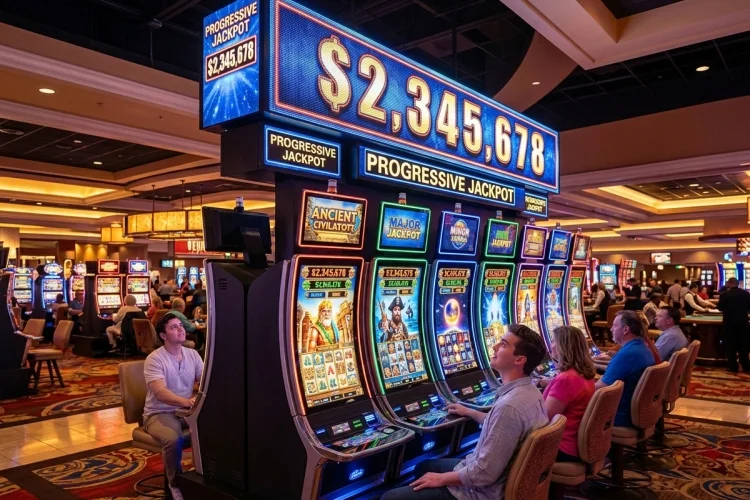
What Are Progressive Jackpot Slots? A Complete Beginner’s Guide

A standard slot usually offers prizes with values defined in its paytable. A progressive slot adds something different: a jackpot whose displayed value can increase over time until an eligible player wins it.

This growing prize is what makes progressive jackpot slots easy to recognize. Their jackpot meters may show amounts far larger than the maximum prizes offered by ordinary slot games.

However, the eye-catching total tells only part of the story. Players must also understand how the prize is funded, which bets qualify, what triggers the jackpot, and how the amount resets after a win.

These details can vary significantly between games. Progressive jackpots are generally associated with infrequent, potentially large awards and high volatility.

They should therefore be treated as entertainment rather than a reliable opportunity to make money. Knowing how the system works will not predict the next winner, but it can help players understand the risks, rules, and true cost of participation.

What Is a Progressive Jackpot Slot?

A progressive jackpot slot is a game connected to a prize pool whose value can increase as qualifying wagers are made.

A configured portion of eligible play may contribute to the growing amount, depending on the game’s mathematical design.

The jackpot normally begins at a predetermined starting or reset value. It rises until the required event occurs, after which the prize is awarded and the meter returns to its stated reset amount.

Regulated-game rules should explain how the jackpot is funded, its starting value, any maximum ceiling, and what happens after a payout. The current meter should also be updated as frequently as practical.

How Does the Jackpot Increase?

Suppose a jackpot begins at $100,000. As eligible players place wagers, the system may direct part of the mathematical return toward the progressive pool.

The amount added from one spin may be extremely small. However, thousands of qualifying wagers across a connected network can cause the meter to rise steadily.

Not every contribution necessarily appears directly on the visible meter. Some systems may use reserve or diversion pools to help fund the next reset value, cover simultaneous wins, or manage jackpot overflow.

Applicable rules should explain how contributions are treated when a jackpot reaches a ceiling.

The Main Types of Progressive Jackpots

1. Standalone Progressives

A standalone jackpot is connected to one game or gaming device. Because it receives activity from a limited source, its meter may grow more slowly than a large networked prize.

2. Local or Linked Progressives

A linked jackpot combines qualifying play from several games within one casino, website, or controlled group. Multiple titles may share the same prize pool.

3. Wide-Area Progressives

A wide-area progressive connects games across multiple participating venues or platforms. GLI defines a multi-site or wide-area progressive as a linked jackpot interconnected between multiple gaming venues

IGT’s wide-area portfolio provides a commercial example of games connected to major shared prizes.

How Can a Progressive Jackpot Be Triggered?

The winning mechanism depends entirely on the rules. Some games require a specific symbol combination, while others award access through a bonus wheel, pick feature, or special jackpot round.

A mystery jackpot works differently. It may be triggered randomly during an eligible play or when the meter reaches a hidden threshold selected by the system.

Gaming Laboratories International states that mystery-triggered jackpots can use random events or randomly selected hidden trigger thresholds.

The RNG and each relevant implementation should be evaluated according to applicable regulatory requirements.

Players should never assume that a full reel of jackpot symbols is required. The game’s help page is the only reliable source for its trigger conditions.

Do You Need to Place the Maximum Bet?

Some progressive slots make the jackpot available at every stake. Others require a minimum wager, particular coin setting, selected side bet, or specific number of active lines.

For example, IGT describes certain mystery progressives as awarding jackpots randomly on qualifying games, with optional required minimum bets applying to particular prize levels.

This illustrates why eligibility must be checked game by game. Increasing the wager should not be assumed to guarantee eligibility or substantially improve the chance of winning.

Regulations in Great Britain state that where players contribute to a pool, eligibility and winning chances should relate fairly to the contribution.

Progressive Jackpots, RTP, and Volatility

RTP is the theoretical percentage of stakes a game is designed to return over extensive play. A progressive slot may display one combined RTP or separate percentages for the base game and jackpot component.

UK technical standards require the available jackpot rules to explain the RTP presentation. They must also identify when a player is ineligible for the progressive award and show the relevant theoretical return.

Progressive jackpots tend to be infrequent and large, giving them high-volatility characteristics. The UK Gambling Commission therefore recommends monitoring the base game and jackpot component separately in certain performance assessments.

A high jackpot meter does not mean a payout is “due.” Random games do not become more likely to award a prize simply because the previous spins lost.

What Happens After Someone Wins?

Once a valid jackpot is triggered, the operator or system verifies the result and awards the stated prize according to the rules. The meter then usually resets to its seed or reset value.

The rules should explain how simultaneous or apparently simultaneous claims are handled, including situations affected by network latency. Eligible players should also be notified when the jackpot has been won and reset.

Payment procedures may depend on the operator, provider, prize size, and jurisdiction. Players should read the payout conditions instead of assuming every jackpot is handled in the same way.

Progressive jackpot slots feature prizes that increase from a starting value until an eligible player triggers the award. They may operate as standalone games, local linked systems, wide-area networks, or multi-level jackpots with several prize tiers.

The growing meter is only one factor to examine. Players should also check the trigger mechanism, minimum qualifying wager, RTP, volatility, reset value, and payment conditions.

Before spinning, open the official paytable and confirm that your chosen stake is eligible. Set a strict entertainment budget and never raise a wager because the jackpot appears close to being won.

Progressive prizes can be large, but the outcome remains uncertain and the entire stake can be lost.

Online Slots

Paylines vs Ways-to-Win Slots Explained Before You Play

Choosing between a payline slot and a ways-to-win game is not simply a question of selecting the format with the largest number.

The number describes how winning symbols can connect, but it does not reveal the whole game model. A 20-payline slot may provide straightforward patterns that are easy to trace.

A 243-way title can pay matching symbols across different rows, while a Megaways game may change its reel layout on every spin. Each system creates a different visual and mathematical experience.

This paylines vs ways-to-win slots explained article focuses on what players should examine before placing a wager.

Rather than treating one mechanic as automatically better, it explains how to read the paytable, identify winning directions, understand the total bet, and separate reel structure from RTP and volatility.

The objective is informed entertainment. Random slot outcomes cannot be predicted from previous spins, and a larger number of possible routes does not remove the casino’s mathematical advantage.

Identify the Game’s Winning System

Open the information menu and look for terms such as fixed paylines, adjustable lines, all ways, adjacent pays, cluster pays, or Megaways. These labels describe different methods of evaluating the final reel arrangement.

In a payline game, matching symbols must normally occupy positions connected by an active pattern. In an all-ways game, their row positions are usually irrelevant as long as they appear on the required adjacent reels.

Do not rely entirely on animations. A slot may draw coloured lines after a win even though its underlying system is based on ways rather than conventional paylines.

Regulated game descriptions should give customers sufficient information about rules, payouts, and winning likelihood before they gamble.

Check Where a Winning Combination Must Begin

Many slots require standard symbol combinations to start on the leftmost reel. Matching symbols then continue through adjacent reels without a gap.

Other games may pay from either direction, while scatter symbols can often award prizes anywhere on the grid. Some bonus icons must appear on particular reels despite not following normal payline rules.

A ways-based format does not automatically mean that matching symbols can appear anywhere. If reels one and two contain a symbol but reel three does not, an identical symbol on reels four and five may not connect with the earlier group.

The exact starting position and direction should always come from the game rules.

Review Fixed and Selectable Paylines

A fixed-line game evaluates every listed pattern on each spin. The player usually selects a total wager, and the software distributes or applies it according to the game’s design.

Selectable-line slots allow some patterns to be switched off. Reducing active lines can lower the total cost, but it also means a symbol sequence on an inactive line will generally not generate a prize.

For example, betting $0.02 on each of 30 active lines costs $0.60 per spin. Activating only 10 lines costs $0.20, assuming the per-line wager remains unchanged.

Before using an adjustable game, check both the line stake and total bet. This avoids mistaking a small denomination for the complete price of one spin.

Understand the Advertised Ways Figure

In a five-reel game showing three symbols per reel, multiplying the positions produces 243 full-length routes. A five-reel game with four visible positions produces 1,024.

The count is based on possible position combinations, not the number of different prize outcomes. It also does not mean the player receives hundreds of independent spins at once.

Several matching symbols on a reel can increase the number of simultaneous winning combinations. This feature often makes ways-based wins appear more complex than line-based awards.

Official game descriptions show that real slots use many configurations. IGT offers titles with 243 ways, Evolution lists 1,024-way slots, and expanding formats can increase the count during a feature.

Examine Dynamic Reel Mechanics

A fixed-ways slot maintains the same grid size on every base-game spin. Dynamic formats vary the number of symbol positions, so the available ways can change from one result to the next.

Megaways is the best-known example. Its reels can display different numbers of symbols, producing thousands of possible routes and a stated maximum that may reach 117,649.

Evolution’s description of Big Time Gaming notes that Megaways uses changing symbol heights of between two and seven positions per reel.

The maximum figure may appear only when every reel reaches its greatest height. Players should not assume that every spin is evaluated with the advertised maximum number.

Compare RTP and Volatility Separately

The winning system is only one part of the slot’s mathematics. RTP and volatility provide different information and should be checked separately.

RTP describes the theoretical long-term percentage returned as prizes. A slot designed with 96% RTP does not promise to return $96 from every $100 deposited or wagered by one player.

The UK Gambling Commission defines RTP as an average achieved over a significant amount of play. Normal variation means an individual session can finish far above or below that percentage.

Volatility concerns how prizes are distributed. Two 243-way games with similar RTPs can deliver very different experiences if one emphasizes frequent smaller prizes and the other concentrates value in rarer features.

Inspect Wilds, Scatters, and Bonus Rules

Wild symbols can substitute for regular icons, potentially creating several line or ways combinations. Expanding and stacked wilds may influence many reel positions simultaneously.

Scatters commonly follow separate rules and may pay regardless of paylines or adjacent-reel sequences. They can also trigger free spins when a required number appears.

Bonus rounds may use a different grid, extra reels, multipliers, cascading symbols, or an increased number of ways. The rules applying during the feature may therefore differ from those in the base game.

Gaming standards expect the rules relevant to a game state or bonus feature to be made clear to the player.

Choose Based on Clarity, Not Hype

A payline game may be preferable when the player wants simple, visible winning patterns. Ways-based slots may appeal to those who enjoy broader reel layouts and multiple simultaneous combinations.

Neither choice provides a reliable strategy for beating the game. A large ways figure is often a design and marketing feature rather than evidence of better financial value.

Use free-play mode where legally available to learn the controls, but remember that demo games should follow the same likelihood of winning as real-money versions in regulated markets.

The final decision should consider understandable rules, affordable stakes, RTP, volatility, and personal entertainment preferences.

Payline slots award combinations along predetermined patterns, while ways-to-win games normally connect matching symbols across adjacent reels regardless of row.

Dynamic systems can vary the reel height and number of available routes on every spin. Before choosing either format, read the winning direction, minimum symbol requirement, total wager, RTP, volatility, and bonus rules.

Do not interpret 243, 1,024, or 117,649 ways as a promise of frequent or profitable results. Select games whose rules you can understand and whose minimum stake fits your budget.

Establish a time and spending limit before starting, stop when either limit is reached, and treat every slot as paid entertainment rather than a source of income.

Payments

How Casino Withdrawals Work Across Different Payment Methods

Choosing a deposit method is easy to treat as a decision about speed and convenience. However, the same choice can influence how money is withdrawn later.

Not every funding option accepts incoming payouts, and different methods use different banks, networks, verification rules, and transfer schedules.

Understanding how casino withdrawals work across payment methods helps players plan the entire transaction journey.

A debit-card payout may use supported card-transfer infrastructure, while a bank withdrawal requires accurate account information.

An e-wallet transfer may arrive quickly in the wallet but still require another transaction before reaching a bank account.

The casino remains responsible for reviewing and approving the request before its payment partner sends the money. Consequently, a fast payout service cannot compensate for a slow internal approval process.

Players should compare withdrawal availability, fees, limits, currencies, and verification conditions before making their first deposit.

They should also ensure that the casino is licensed to operate in their location and that every financial account used belongs to them.

Withdrawals to Debit Cards

Some casinos can return money to an eligible debit card. Instead of charging the card as they would for a deposit, the payment system pushes funds toward the associated account.

Availability depends on the card, issuer, operator, country, and payment program. A casino displaying a card brand for deposits does not guarantee that the same card can receive payouts.

Visa Direct and Mastercard Move both support money movement to multiple types of endpoints, including eligible cards, accounts, and digital wallets. Actual casino availability and delivery speed depend on the participating service providers.

An expired, replaced, or unsupported card may require an alternative payout arrangement and additional verification.

Bank-Transfer Withdrawals

Bank transfers are widely used when the customer provides an account number and other required banking details. Domestic transfers may be simpler, while international payouts can involve intermediary institutions and currency conversion.

Entering incorrect information can cause rejection, delay, or a return of the funds to the casino. Players should copy bank details carefully and confirm that the account accepts the selected currency.

Traditional bank rails may require several days in some markets, particularly when transfers are processed in batches.

The casino’s stated processing period normally occurs before the banking period begins. A payment approved today may therefore arrive later, even though it already shows as processed in the casino account.

E-Wallet Withdrawals

An e-wallet can receive money into a separate digital balance. The player may then spend the funds through that service or transfer them to a linked bank account.

This can make e-wallet withdrawals convenient, but two transaction stages may be involved: casino to wallet, followed by wallet to bank. Each stage can have its own limits, fees, and processing period.

Timing also varies by market. PayPal’s official help pages, for example, publish different bank-transfer estimates and fee arrangements across countries, demonstrating why users should consult the terms applicable to their own accounts.

The wallet and casino accounts should generally use matching customer information.

Prepaid and Deposit-Only Methods

Prepaid vouchers and similar products may help players control deposit spending, but many cannot receive withdrawals. Their function ends once the code or stored value has been used.

When a deposit-only method is selected, the casino may ask the player to nominate a bank account or e-wallet for payouts. This often requires proof that the customer controls the alternative destination.

The operator should explain this limitation before the deposit is made. Players should not assume that winnings can be returned as a new voucher.

Using a prepaid method also does not remove normal identity and account-verification requirements.

Why the Original Method Is Often Preferred

Returning funds through the original payment route can help reduce fraud and prevent a casino account from being used to transfer money between unrelated financial accounts.

Suppose a player deposits through one card and requests a payout to another person’s bank account. The operator may pause the transaction because the destination cannot be connected clearly to the verified customer.

The casino may also need to refund deposited amounts to the original method before sending remaining winnings elsewhere. Procedures vary, so the payment policy should explain the order used.

Players should never use a payment method without the account holder’s permission or attempt to bypass ownership checks.

Fees, Limits, and Currency Conversion

Withdrawal costs can arise from the casino, receiving institution, e-wallet, intermediary bank, or currency conversion. A “free withdrawal” claim may refer only to the operator’s own charge.

Review the minimum payout, daily or monthly maximum, number of free transactions, and fee for smaller withdrawals. Also check whether a large balance must be paid in instalments.

In Great Britain, customers are entitled to withdraw their deposit funds and related winnings without an arbitrary maximum withdrawal restriction. Any permitted processing charge must reflect the direct cost and be disclosed before deposit.

Rules vary internationally, making local licensing terms important.

Verification and Payment Security

A payout request may prompt checks of identity, payment ownership, or transaction activity. These reviews should follow a clear process and should not be used merely as an excuse to postpone payment.

UK guidance says operators cannot demand age and identity proof solely as a withdrawal condition when they could reasonably have requested it earlier. New information may still be required when a later legal or financial risk emerges.

Submit documents through the casino’s official secure portal. Hide unrelated information only when the operator confirms that redaction is permitted.

Never disclose complete passwords, wallet recovery phrases, or one-time banking codes.

Escalating a Payment Dispute

When a payout does not arrive, determine whether it remains with the operator or has been sent to the payment provider. Ask for a payment reference that the receiving institution can trace.

If the casino has not resolved the matter, use its formal complaint procedure. Include the account details, amount, request date, status history, and relevant correspondence.

Customers dealing with UK-licensed operators must generally complain to the business first. Certain unresolved transaction disputes can then proceed to independent ADR, while the Gambling Commission does not recover individual balances directly.

The Malta Gaming Authority similarly recommends contacting the licensed operator before lodging a complaint through its formal player channel.

Card payouts, bank transfers, and e-wallet withdrawals move through different financial systems. Each option can have distinct eligibility rules, fees, limits, currencies, and delivery periods, while prepaid methods may not support withdrawals at all.

Before depositing, identify which payout routes are available and whether the original method can receive money.

Confirm that all payment accounts use your own verified details and review the operator’s internal processing period separately from external transfer time.

Keep transaction references and escalate unresolved issues through official complaint channels. Above all, submit withdrawals according to a predetermined budget and avoid reversing them to continue playing.

Gambling funds should remain limited to money you can comfortably afford to lose.