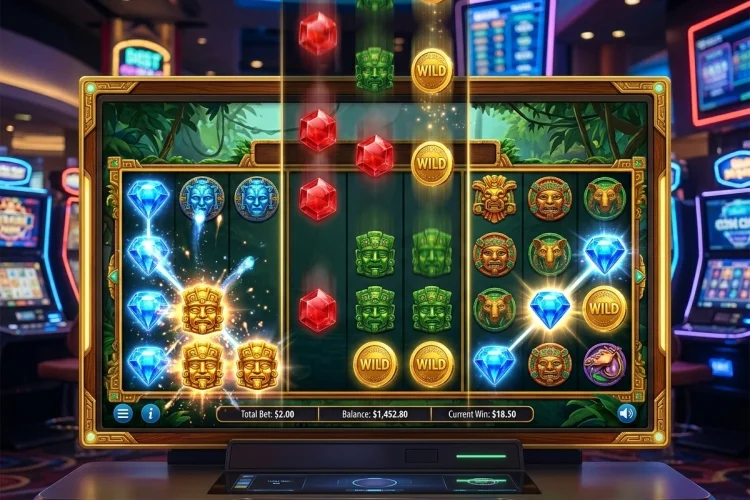
Table Games

Online Baccarat vs Live Dealer Baccarat: Speed, Tech, and Experience

Digital baccarat can deal a new hand almost as soon as you click a button. Live baccarat takes a more traditional route: wagers close, a

Read More

Table Games

How Roulette Payouts Work: Odds, House Edge, and Wheel Types

Seeing a 35:1 payout beside a single roulette number can make it look like the obvious high-reward choice. Yet the same table also offers 17:1,

Read More
Table Games

When to Hit, Stand, Split, or Double Down: A Practical Guide

The hardest part of blackjack is rarely adding the cards. The real challenge is knowing what to do after you see your total and the

Read More
Table Games

Online Baccarat vs Live Dealer Baccarat: Speed, Tech, and Experience

Digital baccarat can deal a new hand almost as soon as you click a button. Live baccarat takes a more traditional route: wagers close, a dealer handles physical cards, the hands are completed, and the result appears while players watch through a video stream.

That makes Online Baccarat vs Live Dealer Baccarat an interesting comparison even though both versions are built around the same basic objective.

The differences show up in pace, production technology, table atmosphere, bandwidth, betting options, and how much control the player has over the timing of each round.

Digital Baccarat Is Built Around RNG Technology

Online baccarat usually generates its results electronically.

An RNG selects outcomes according to the mathematical rules of the game, while the interface creates the cards, table, animations, and balance updates.

Evolution’s First Person Baccarat is a useful example because the company clearly identifies it as an RNG-based version. It provides six standard and six No Commission tables and lets players control when hands are dealt.

RNG games operating under the UK Gambling Commission’s standards must generate acceptably random results, meaning the output must be demonstrably random and unpredictable through recognised testing.

That process is very different from filming physical cards, even though the result on your screen may look realistic.

Live Baccarat Needs a Complete Studio Operation

Live dealer baccarat requires much more physical infrastructure.

There is a real table, real cards, a trained dealer, cameras, studio lighting, and software connecting the physical game to players’ digital bets.

The UK Gambling Commission’s live dealer standards call for commercial-quality equipment, trained croupiers, supervisory staff, surveillance, controlled access, and game logs for relevant regulated studios.

The dealer is therefore only the visible part of a larger operation.

Behind the camera are systems responsible for broadcasting the game, recording events, monitoring the table, and connecting accepted wagers with the correct round.

This is why live dealer baccarat feels much closer to an actual casino table than a standard computer-generated game.

Speed Is One of the Biggest Differences

Traditional live baccarat takes time.

Evolution states that one standard baccarat round typically lasts around 48 seconds. Its Speed Baccarat product shortens that to around 27 seconds by dealing cards face-up and keeping result time to a minimum.

An RNG product does not need a dealer to physically complete these steps.

That makes self-paced digital baccarat potentially much faster.

This matters because game speed influences how many wagering opportunities can occur during the same session.

For example, placing $2 on 40 rounds represents $80 in base wagering volume. The same $2 across 100 rounds represents $200.

The rules may be identical, but the pace can change how frequantly money cycles through the game.

Live Baccarat Offers More of a Casino Atmosphere

Some players enjoy baccarat partly because of its presentation.

Live versions preserve many of those visual elements: the card table, dealer movements, road maps, and sometimes specialised rituals such as card squeezing.

Evolution even offers Live Baccarat Squeeze, a production that uses numerous cameras to capture detailed card-reveal sequences. Its live portfolio also includes standard and faster variants.

Digital baccarat tries to recreate part of that environment through animation.

First Person Baccarat uses a 3D casino-style hall and familiar Evolution interface, but the player remains in control of the software-generated game.

So the choice depends partly on whether you value efficiency or atmosphere.

Table Limits and Availability Can Feel Different

A physical live table operates as part of a studio.

Providers may therefore create several tables with different stakes, languages, rules, speeds, or themes.

Evolution’s standard baccarat product is offered across a range of tables designed for different players.

Pragmatic Play similarly supports its live baccarat across desktop and mobile while providing standard and No Commission modes.

RNG baccarat does not require a physical table for each option.

A single software product can offer several simulated tables or configurations at once. First Person Baccarat, for example, gives users access to 12 digital tables.

Before joining either type, check the minimum and maximum stakes rather than assuming the digital table will always be cheaper.

Commission Rules Matter More Than Whether the Dealer Is Live

The word “live” does not determine whether Banker wins pay using standard commission rules.

The specific baccarat variant does.

Traditional baccarat commonly applies commission to Banker wins, while No Commission products modify the payout structure.

Evolution’s live No Commission Baccarat pays most winning Banker wagers at 1:1 but pays only 0.5:1 when Banker wins with six.

Its RNG First Person Baccarat includes No Commission tables as well.

This shows why the production format is not the most important mathematical detail.

Two live baccarat tables can have different payout rules, while an RNG and live version can sometimes follow nearly identical structures.

Always read the game-specific paytable.

Side Bets Can Change the Experience

Standard baccarat is relatively simple.

Modern online versions frequently add optional wagers to increase variety.

Pragmatic Play’s live Baccarat includes multiple side bets along with the traditional baccarat roads.

Evolution’s Ezugi Baccarat includes Perfect Pair, Either Pair, Player Pair, and Banker Pair wagers.

RNG versions can take the idea even further through software-driven features. First Person Lightning Baccarat randomly selects Lightning Cards and assigns them payout multipliers.

These additions can make two baccarat products feel completely diferent despite sharing the same Player-versus-Banker foundation.

Read every optional wager separately because the main game’s payout structure does not automatically apply to side bets.

Connection Quality Matters More for Live Play

Live baccarat relies on continuous streaming.

The video, game interface, betting timer, and results all need to arrive in coordination.

A weak connection can create buffering or reduce video quality.

RNG baccarat usually handles slower connections more easily because most of the visual environment is generated digitally rather than transmitted as continuous studio video.

An internet interruption can still matter in either version.

UK Gambling Commission standards require regulated operators to have fair policies for interrupted gaming, including procedures for wagers already accepted and, where appropriate, restoration or voiding of affected game states.

Knowing the operator’s interruption policy can therefore be useful, especially for live play.

Baccarat Roads Exist in Both Formats

Bead Road, Big Road, and other baccarat road displays are strongly associated with casino baccarat.

They are no longer exclusive to live games.

Pragmatic Play’s live baccarat includes five traditional baccarat roads.

Evolution’s First Person Baccarat also lets players sort digital tables using roads or streaks and even deal free hands to create additional histories.

That makes RNG baccarat surprisingly similar in presentation.

However, road maps document previous results. They do not guarantee what the next hand will be.

In an RNG game, outcomes must remain unpredictable under applicable standards.

A visible Banker streak therefore should not be treated as proof that another Banker result—or Player reversal—is guaranteed.

Live Variants Can Become Much More Elaborate

Live baccarat is no longer limited to one classic format.

Evolution currently offers variants such as Speed Baccarat, No Commission Baccarat, Insurance Baccarat, and multiplier-based games.

RNG versions can mirror some of these concepts.

Evolution’s Prosperity Tree Baccarat, for example, has both live and First Person RNG implementations using related multiplier mechanics. The First Person version allows users to play at their own pace.

The boundary between “online” and “live” is therefore becoming less rigid.

The same idea can exist as both a studio product and a software-driven product.

Which One Fits Your Playing Style?

RNG baccarat suits players who prefer self-paced games, quicker rounds, less streaming, and fewer interruptions from table presentation.

Live dealer baccarat suits people who value real cards, human dealers, shared rounds, and casino-style atmosphere.

Neither format should be treated as automatically offering better returns.

Rules such as Banker commission, side-bet payouts, fees, and special multiplier mechanics can matter much more.

Also consider pace. A faster digital game can make it easier to place many wagers in a short period, so a fixed session budget remains important regardless of format.

Online Baccarat vs Live Dealer Baccarat is mainly a choice between digital control and physical casino presentation. RNG baccarat offers self-paced gameplay and lighter streaming demands, while live baccarat provides real dealers and a shared studio experience.

Before choosing, compare the commission rules, table limits, side bets, fees, and round speed. Those details usually matter more than whether the cards are animated or physically dealt.


Table Games

How Roulette Payouts Work: Odds, House Edge, and Wheel Types

Seeing a 35:1 payout beside a single roulette number can make it look like the obvious high-reward choice. Yet the same table also offers 17:1, 11:1, 8:1, 2:1, and 1:1 wagers, each covering a different portion of the wheel.

To fully understand How Roulette Payouts Work, you need to look at both sides of the equation: what a successful wager pays and how many outcomes can make it win.

The wheel type matters too. European, American, and French roulette may share similar payout tables while producing noticeably different house edges.

Roulette Payouts Are Based on Coverage

The easiest way to understand roulette payouts is to compare the number of pockets covered by each wager.

A straight-up bet covers one number and traditionally pays 35:1. A split covers two and pays 17:1. A three-number street pays 11:1, while a four-number corner pays 8:1.

Cover six numbers with a six-line wager and the payout falls to 5:1.

Dozens and columns cover 12 numbers and pay 2:1, while even-money wagers such as red/black and odd/even cover 18 numbered pockets and pay 1:1.

The basic trade-off is clear.

More coverage means a greater chance of including the winning number, but a smaller prize when that happens.

Straight-Up Bets: High Payout, Low Hit Rate

The famous 35:1 straight-up payout is roulette’s largest standard individual wager payout.

On a European wheel, one selected number represents one winning result out of 37 possible pockets.

On an American wheel, it represents one out of 38.

The payout remains 35:1 in both versions despite that difference.

If you wager $2 on number 23 and the ball lands there, the wager earns $70 in profit. Your $2 stake returns as well, making the total return $72.

If any other pocket wins, the $2 wager is lost.

The large payout therefore reflects a small winning chance rather than unusually good mathematical value.

Inside Bets Offer Several Levels of Coverage

Inside bets are placed within the numbered section of the layout.

Beyond straight-up wagers, the most common examples are splits, streets, corners, and six lines.

A $10 split paying 17:1 creates $170 profit when successful.

The same $10 on a corner paying 8:1 produces $80 profit.

The corner offers the smaller payout because it covers four numbers rather than two.

This can change the feel of a session considerably.

A player making broader inside wagers may see qualifying outcomes more frequently, while a straight-number player can experience longer periods without a winning result.

Neither pattern changes the basic house advantage on standard single-zero roulette because the payout schedule adjusts for the additional coverage.

Outside Bets Create Smaller but More Frequent Payouts

Outside wagers cover much larger groups of numbers.

Dozens and columns pay 2:1, while red/black, odd/even, and 1–18/19–36 pay 1:1.

Suppose you wager $30 on black.

A successful result gives you $30 profit plus your $30 stake.

It sounds close to a coin flip, but the presence of zero changes the calculaton.

On single-zero roulette, 18 numbers are red, 18 are black, and one is green. On American roulette, 0 and 00 are both green, increasing the number of outcomes that defeat either colour wager.

That difference is the foundation of roulette’s house edge.

Why European Roulette Has a Lower House Edge

European roulette contains 37 pockets: numbers 1 through 36 plus a single zero.

For most standard bets, the theoretical house edge is approximately 2.70%.

Take a $1 straight-up wager.

If the winning number lands, the standard 35:1 payout creates $35 profit. However, fair odds for one successful outcome among 37 possible results would need to be slightly better than that.

The difference produces the casino advantage.

The same basic gap appears across standard splits, streets, corners, dozens, and even-money wagers.

This is why switching between normal bet types does not remove the house edge.

It mainly changes the payout distribution.

American Roulette Adds Double Zero

American roulette has 38 pockets.

The numbers 1–36 and zero remain, but a second green pocket marked 00 is added. Evolution identifies this as the core difference between its American and European formats.

Standard payouts do not normally increase to compensate.

A single number still pays 35:1. Red still pays 1:1.

As a result, Wizard of Odds calculates a house edge of approximately 5.26% on most conventional American roulette bets.

That is almost twice the standard percentage for a single-zero wheel.

The lesson is important: the same payout does not necessarily mean the same expected mathematical return.

Always check how many pockets exist on the wheel.

French Roulette Can Change Even-Money Results

French roulette usually uses the same 37-pocket single-zero wheel as European roulette.

However, some French tables apply special rules to even-money wagers.

Evolution describes La Partage as a rule where a player loses only half of an even-money wager when the ball lands on zero.

Wizard of Odds calculates that this type of half-back treatment can reduce the house edge on qualifying even-money bets to around 1.35%.

For example, imagine wagering $20 on red.

Under a standard European table, zero normally means the entire $20 loses. With La Partage, only half would be lost, with $10 returned.

That apparently small rule significantly changes long-term mathematical value.

House Edge Is Different From Payout Size

A common mistake is ranking roulette bets by their advertised payout.

A 35:1 straight-up bet looks dramatically more rewarding than a 1:1 red wager.

But payout size alone ignores frequency.

Under standard European roulette, both types have the same approximately 2.70% house edge. Under normal American rules, both are generally around 5.26%.

What changes is volatility.

Straight-up betting tends to produce infrequent large payouts, while even-money betting tends to produce more frequent but much smaller wins.

Those are different risk patterns, not a way to make the mathematical casino advantage disappear.

Watch Out for the American Five-Number Bet

Most standard American roulette wagers share a 5.26% house edge, but there is an important exception.

The five-number wager covers 0, 00, 1, 2, and 3 and traditionally pays 6:1.

Wizard of Odds calculates its house edge at approximately 7.89%.

So even on the same wheel, not every payout schedule is equally efficient.

The bet covers five of 38 possible outcomes but does not pay enough to maintain the same house edge as most other conventional wagers.

This is a good example of why you should compare both payout and coverage instead of memorizing only the headline odds.

Modern Roulette Can Modify Traditional Payouts

Branded online roulette games increasingly add multipliers and bonus mechanics.

Evolution’s Lightning Roulette is one example. Its ordinary non-multiplied straight-up wager pays 29:1 instead of the traditional 35:1, while randomly selected Lucky Numbers can receive much larger payouts. Other wagers such as splits, corners, dozens, and red/black retain conventional roulette payouts.

Pragmatic Play’s Lucky 6 Roulette uses the European format but assigns six random Lucky Numbers with possible multipliers ranging from 50x to 2,088x for qualifying straight-up wagers.

Other newer products can add bonus rounds or still larger multipliers.

These games demonstrate why you should not assume every product labelled “roulette” follows the traditonal 35:1 structure.

Read the specific paytable.

Past Spins Do Not Change the Payout Table

A wheel history showing ten black outcomes in a row does not increase the payout on red.

It also does not alter how many pockets red covers.

The next qualifying red wager still pays according to the same 1:1 table rules.

Changing stake size after previous wins or losses does not change the underlying payout or wheel structure either.

Betting systems can change how much money is exposed from one spin to another, but they do not remove the mathematical advantage built into standard payouts and zero pockets.

Understanding this distinction makes the payout table much more usefull than trying to find patterns in previous results.

Understanding How Roulette Payouts Work requires looking at payout ratios, number coverage, and wheel design together.

European roulette usually offers a smaller house edge than double-zero American roulette, while French rules can improve some even-money outcomes further.

Modern multiplier games may change traditional payouts completely. Before placing a wager, check the number of zeros, payout table, and any special rules first.

Table Games

When to Hit, Stand, Split, or Double Down: A Practical Guide

The hardest part of blackjack is rarely adding the cards. The real challenge is knowing what to do after you see your total and the dealer’s upcard.

A hand that looks weak can sometimes be a stand, while a decent-looking hand may actually need another card. This guide explains When to Hit, Stand, Split, or Double Down using basic-strategy logic rather than intuition.

The exact play can vary according to blackjack rules, but learning why these decisions change is more useful than trying to memorize a few isolated tips.

Basic Strategy Is About Expected Value

Blackjack basic strategy does not attempt to predict individual cards.

Instead, it compares the expected value of legal actions using probabilities generated by the player’s cards, dealer upcard, and rules.

Sometimes the “best” action still has a negative expectation.

For example, when every available option is mathematically unfavorable, basic strategy chooses the action expected to lose the least over many similar situations.

Wizard of Odds describes basic strategy in essentially this way: the correct action aims for the greatest average win or smallest average loss.

This explains many decisions that initially seem counterintuitive.

You are not searching for a guaranteed winning move. You are choosing between different levels of mathematical risk.

Hard Hands: Start With the Easy Decisions

A hard hand has no Ace counted as 11.

Hard 17 or higher is generally easy: stand. Taking another card introduces too much bust risk.

At the other extreme, very low hard totals generally need another card.

The interesting area is hard 12–16.

Under a common multi-deck game where the dealer stands on soft 17, basic strategy generally stands on hard 13–16 against dealer 2–6 and hits against 7 through Ace. Hard 12 is typically stood against 4–6 and hit against the other dealer upcards.

These choices are based on the dealer’s statistical position, not on a belief that low dealer cards must bust.

Why Dealer 2–6 Changes the Decision

Dealer cards from 2 through 6 are often called weaker upcards because the dealer faces more situations where mandatory drawing can eventually produce a bust.

Players sometimes misinterpret this as meaning the dealer is “likely to lose.”

That is too simplistic.

The point is that the relative expected value of standing can improve enough that hitting your own stiff total becomes less attractive.

Suppose you have hard 15 against dealer 6.

Your hand is not strong. But hitting introduces a considerable chance of busting immediately, while standing leaves the dealer to complete the hand according to fixed rules.

Against dealer 10, the situation changes because 15 is now competing with a much stronger visible dealer card.

That is why the same total can require two completely differnt actions.

Soft Hands Give You More Flexibility

Soft hands contain an Ace currently valued at 11.

Ace-5, for example, is soft 16. If you hit and receive a 10, you do not bust; the Ace changes to a value of 1 and the hand becomes hard 16.

This safety cushion changes strategy substantially.

Soft totals often create situations where doubling becomes mathematically preferable against weaker dealer upcards. If doubling is unavailable, hitting can replace the recommended double in many cases.

Soft 18 illustrates how flexible the strategy becomes.

Depending on the dealer card and exact rules, the correct decision can be to stand, double, or hit. Wizard of Odds notes that if a recommended soft double is unavailable, the fallback is usually to hit, with soft 18 being a notable case where standing can apply.

So do not treat soft 18 exactly like hard 18.

Doubling Is About Strong Starting Opportunities

Doubling down is powerful because it allows you to increase the wager when your first two cards create a favourable situation.

But the cost is important: after doubling, you normally receive exactly one additional card and must stand.

That makes starting totals of 9, 10, and 11 especially relevant.

Under many common rules, hard 10 doubles against dealer 2–9. Hard 11 often doubles against 2–10, while hard 9 has narrower doubling opportunities.

However, the correct boundaries change with rules.

For example, Wizard of Odds notes that dealer hit-or-stand rules on soft 17 can alter specific doubling recommendations.

That is why a basic strategy chart should match the actual table rather than simply being labelled “blackjack strategy.”

Splitting Is Not About Making More Hands

Splitting creates two hands and requires an additional wager equal to the original bet, so it should never be done just because playing two hands seems more exciting.

The classic basic-strategy rule is to split aces and eights in standard blackjack situations.

Aces benefit because two separate Ace-based hands have better potential than keeping a total of 2 or 12.

Eights benefit for another reason: hard 16 is a notoriously awkward starting hand. Splitting changes the structure and can produce a better expected outcome, even though the decision increases the amount at risk.

Expected-value comparisons from Wizard of Odds show situations where splitting eights loses less on average than the alternatives.

This is an important distinction: mathematically preferable does not mean guaranteed profitable.

Why Tens and Fives Are Usually Not Split

Two tens already give you 20.

Breaking that strong hand into two starting hands with a value of 10 usually sacrifices substantial value. Pagat notes that splitting tens is almost always poor standard blackjack play.

Fives create a different situation.

Two fives equal 10, which is an attractive doubling total against many dealer upcards. Splitting would turn that useful total into two weak starting hands.

For this reason, many strategy charts omit a normal split instruction for fives and instead treat the pair as hard 10.

Remembering the logic makes these rules easier than memorizing every pair individually.

Splitting Twos Through Nines Is More Situational

The middle pairs depend heavily on the dealer’s upcard and whether doubling after splitting is allowed.

For example, pairs of twos, threes, sixes, sevens, and nines may be split against selected dealer cards while being hit or stood in other situations.

Rules permitting double after split, often shortened to DAS, can make splitting certain pairs more attractive because each new hand retains the possibility of doubling.

Wizard of Odds therefore provides separate strategy treatment based on whether doubling after a split is permitted.

This is a good example of why copying one chart without checking table conditions can produce strategy errors.

Rules that appear small can change the optimum play.

Dealer Soft 17 Is More Important Than It Sounds

A table may state either S17 or H17.

S17 means the dealer stands on all 17s, including a soft 17 such as Ace-6. H17 means the dealer must hit soft 17.

That single rule affects the house edge and can change certain player decisions.

Wizard of Odds’ basic strategy calculator specifically asks whether the dealer hits or stands on soft 17, along with deck count, doubling rules, surrender, and dealer-peek rules.

Another major rule is blackjack payout.

A 3:2 payout and a 6:5 payout are not equivalent, and the payout structure can materially affect the mathematical value of the game. Wizard’s house-edge calculator includes blackjack payout among the rules used to calculate the casino advantage.

Always read the table information first.

Avoid Making Decisions Based on Previous Hands

Blackjack naturally encourages pattern-seeking.

You might lose after hitting 16 several times and decide that standing “works better,” or receive low cards after several doubles and stop doubling entirely.

That is not how basic strategy is evaluated.

One hand or one session cannot establish whether an action is mathematically correct. Strategy calculations compare huge numbers of possible card outcomes rather than a few memorable results.

The UK Gambling Commission describes blackjack as a banker game with an inherent house advantage, while game rules and house-edge information should be made available in regulated casino settings under its framework.

Use the appropriate strategy chart rather than changing decisions because of a recent winning or losing streak.

Bankroll Rules Still Matter

Correct strategy can reduce avoidable decision errors, but it cannot turn blackjack into guaranteed income.

Doubling and splitting are especially important for bankroll planning because both can increase the money committed to one original round.

If you bet $10 and split, you normally need another $10. If one of those hands is later eligible for a double, even more money can become exposed.

Your planned stake should therefore leave room for legitimate strategy decisions without forcing larger spending than intended.

GamCare recommends setting a money limit and time limit before gambling, and specifically warns against chasing losses.

Strategy and bankroll control solve differnt problems: one concerns mathematical decisions within the game; the other concerns how much risk you choose to take.

Understanding When to Hit, Stand, Split, or Double Down becomes easier when you separate hard totals, soft hands, and pairs, then compare each with the dealer’s visible card.

Exact strategy changes with deck count and table rules, so check those details first. Use a matching basic-strategy chart, keep your stakes within a fixed budget, and avoid changing mathematically sound decisions because of short-term results.

Live Casino

Live Dealer Casino Games Explained: Tables, Tech, and Smart Basics

A live casino table can make online gambling look surprisingly close to sitting inside a physical casino. You see a dealer, watch cards being dealt or a wheel being spun, and place wagers through the same screen – all without visiting a casino floor.

Behind Live Dealer Casino Games, however, is a fairly sophisticated mix of broadcasting, software, betting controls, and game procedures.

Beginners should understand more than just where the bet button is. Table speed, variants, side bets, streaming quality, limits, and licensing can all change the overall experiance considerably.

Live Dealer Games Are Not the Same as Standard Digital Games

Traditional digital casino games generally use software to create and display the entire gaming experience.

Live dealer games instead include a physical or live-presented element transmitted from a studio.

Evolution says its studios operate much like advanced TV or film production facilities, broadcasting real-time casino games while software lets remote players place wagers and communicate through an online interface.

This makes live games feel more social and visually transparent.

But it does not change the fundamental nature of gambling. Outcomes remain uncertain, and the table’s rules and payout structure still determine the mathematical conditions of each wager.

The Main Live Table Categories

The largest live casino lobbies typically contain several familiar game families.

Blackjack is popular because players make decisions after receiving cards. Baccarat involves fewer player decisions because bets are normally placed on outcomes such as Banker, Player, or Tie.

Roulette offers many wager types across the number grid, while some providers also stream craps, poker-style casino games, Sic Bo, and regional games.

Evolution’s current live portfolio includes blackjack, roulette, baccarat, poker, dice and craps, plus game-show products.

Availability varies depending on the operator and local regulation, so not every casino will offer the same tables.

Table Variants Can Change the Rules

Two tables carrying the same game name can operate differently.

Take baccarat as an example. Standard baccarat may apply a commission to certain Banker wins, while a no-commission version can change the payout when Banker wins with a particular total.

Evolution’s Ezugi No Commission Baccarat pays Banker wins at 1:1 except when Banker wins with six, where the listed payout is 0.5:1.

That is a meaningful rules change.

Similarly, blackjack variants may differ in seat count, side bets, game pace, or other table conditions.

Never assume familiarity with one version means every table uses identical rules.

Speed Tables Change How Quickly Money Can Be Wagered

Speed is an easy feature to overlook.

Evolution’s standard Baccarat is described as taking roughly 48 seconds per round, while its Speed Baccarat version can complete a round in about 27 seconds.

Its Speed Roulette product advertises roughly 25-second rounds.

Faster rounds do not automatically improve or worsen the underlying wager. What they change is how many betting opportunities can occur within a session.

Suppose someone makes a $2 wager every round. Playing twice as many rounds in the same hour can produce roughly twice as much total wagering volume if the stake remains unchanged.

That makes game speed highly relevent to bankroll planning.

Table Limits Should Match Your Entertainment Budget

Every live table has a betting range.

You may find low-stake tables intended for casual players and higher-limit environments designed for larger bankrolls. Evolution’s roulette offering, for example, includes standard and VIP formats with different minimum and maximum bets.

Choosing the right minimum matters.

If your session budget is $50, a $1 minimum gives considerably more flexibility than a $10 minimum.

That does not guarantee the money lasts longer because results vary. But mathematically, smaller wagers allow a fixed bankroll to cover more rounds before accounting for wins.

Look at the table limit before becoming interested in its design, dealer, or bonus features.

Side Bets Deserve Their Own Research

Optional bets are common in live dealer games.

A blackjack table might include Perfect Pairs or a card-combination side wager. Baccarat can offer Player Pair, Banker Pair, Either Pair, and other alternatives.

Evolution’s Ezugi Baccarat provides several such options.

These bets can have completely differnt payout structures from the main game.

Do not assume that a 25:1 or 100:1 headline payout automatically makes a wager attractive. Larger payouts are usually associated with less frequent outcomes, and the exact mathematical value depends on the probabilities and rules.

Treat every side bet as a seperate game within the table and read its paytable before using it.

Live Game Shows Use Different Presentation Styles

Modern live casino studios are not limited to classic green-felt tables.

Live game shows use presenters, large wheels, bonus stages, multipliers, augmented graphics, and entertainment-style studio sets.

Evolution’s game-show catalogue includes titles such as Crazy Time, Dream Catcher, MONOPOLY Live, and other formats built specifically around live presentation.

Pragmatic Play also operates live casino and game-show products, showing how this category has expanded beyond traditional table formats.

The presentation can be more elaborate, but the practical rule stays the same: know what you are betting on and how each outcome pays.

Streaming Technology Can Affect the Experience

Video quality matters because you are watching a live broadcast while interacting with the betting software.

A weak connection can create delays, lower resolution, or interrupted streams. Well-designed platforms therefore need to synchronize video, betting windows, game results, and account information.

Providers use multiple cameras and specialised production systems to present different angles of the action.

Evolution’s Immersive Roulette, for example, uses multiple cameras and high-frame-rate footage to provide close-ups and slow-motion views of the wheel.

This technology improves presentation, but players should still rely on the official digital game result and interface rather than trying to judge outcomes manually from video alone.

Check Whether the Product Is Truly Live

The term “live-style” can occasionally cause confusion.

Some products may use dealer footage without having a live dealer performing the current round.

Evolution’s EZ Dealer Roulette is one example of a hybrid approach. It combines prerecorded dealer video with RNG-based outcomes.

By contrast, standard live roulette broadcasts a physical wheel and dealer activity in real time.

Neither format needs to be considered inherently better simply because of presentation.

What matters is understanding which system you are using so the game’s mechanics are tranparently understood.

Licensing Still Happens at the Casino Level

A recognised game provider does not automatically prove that every website offering its games is appropriately licensed for your jurisdiction.

In Great Britain, online gambling operators serving consumers must hold the relevant Gambling Commission licence. The regulator advises consumers to verify companies through its public register before gambling.

Different countries and regions have their own laws.

Check the operator behind the website, not only the studio or game-provider logo.

Also review terms covering withdrawals, complaints, account verification, and customer funds before making a deposit.

Use Limits Before a Fast Session Starts

Live tables can feel more engaging because there is always another round beginning.

That makes it useful to decide both a maximum stake and a session budget in advance.

Financial-limit tools can also help where provided. In Great Britain, updated technical standards require online gambling systems to provide accessible facilities for customers to set financial limits, with further deposit-limit requirements scheduled to take effect on September 30, 2026.

A limit works best when it is established before emotions or previous results influence the decision.

A losing round does not make the next one obligated to repay it.

Live Dealer Casino Games bring real tables, dealers, cameras, and digital betting controls together in a single online format. The best way to understand them is to compare rules rather than appearances.

Check table speed, limits, side bets, game variants, and licensing before participating. If you decide to play, choose stakes that fit a predetermined entertainment budget and keep session boundaries clear.

Online Slots

How Cascading Reels Work With Multipliers and Bonus Features

One winning result turning into two, three, or several consecutive symbol drops is now a familiar sight in online slots.

What started as a distinctive mechanic has developed into a flexible system that developers combine with multipliers, free spins, clusters, expanding reels, and other modifiers.

Learning How Cascading Reels Work becomes especially useful when these extra features appear. A cascade itself is fairly simple, but what happens during and after each drop varies widely between games.

Understanding those differences helps you read a slot’s paytable without confusing flashy animations with its actual mathematical rules.

Cascading Reels Replace Winning Symbols

The foundation of the mechanic is straightforward.

A winning group is identified, the symbols contributing to that result disappear, and replacement symbols fill their positions. The revised layout is then checked for another qualifying win.

If another win appears, the procedure repeats.

Pragmatic Play describes this clearly in Sweet Bonanza. After a winning combination lands, those symbols vanish and replacements drop onto the reels from above.

Jewel Rush follows the same broad principle, with winning symbols removed and cascades continuing until there are no more matching combinations.

Although developers may call the feature cascading, tumbling, collapsing, or Avalanche reels, the underlying concept is closely related.

Why Cascades Feel Different From Regular Re-Spins

A cascade should not automatically be confused with a respin.

In a typical respin mechanic, some or all reels may spin again under specific feature rules. A cascading mechanic usually modifies the existing result instead by removing winning symbols and filling the spaces they leave.

Visually, this creates a sense of continuity.

You are watching the original grid change rather than simply seeing another completely seperate reel spin.

That distinction matters because multipliers and bonus features may remain active across the cascade sequence even though they would reset when a new ordinary spin begins.

Always check the game’s own terminology, because studios can implement these features differently.

Multipliers Can Build Across Consecutive Wins

One reason cascading reels became popular in modern slot design is that they pair naturally with increasing multipliers.

Gonzo’s Quest provides an early well-known example. Each Avalanche increases its win multiplier by one step, with the game’s multiplier able to reach 5x during the sequence.

Modern games can take the concept further.

In Gates of Olympus 1000, multiplier symbols with values from 2x to 1,000x can appear while tumbling wins are taking place. Multiple relevant multiplier values can be combined and applied according to the game’s rules.

The result is that a later cascade can sometimes have considerably more payout potential than the opening combination.

However, multipliers do not always increase simply because another cascade occurs.

Persistent and Additive Multipliers Work Differently

Different games handle multiplier symbols in different ways.

Sweet Bonanza provides a useful example. During its free-spins feature, multiplier symbols can appear with values from 2x to 100x. At the end of a qualifying tumbling sequence, those values can be combined.

Newer titles have expanded on this concept.

Sweet Bonanza 2500 allows multiplier symbols to remain visible during tumbles before being combined and applied to the total win. Its multiplier values can reach 2,500x in the bonus game.

Gates of Olympus Super Scatter uses another variation where multiple multiplier symbols can add together, while multiplier values during its free-spin feature contribute to a running total.

These variations show why reading the paytable matters more than simply recognising the cascade animation.

Cascades Can Combine With Pay-Anywhere Systems

Traditional slots often require matching symbols to appear along predefined paylines.

Many cascading games instead use pay-anywhere or cluster-based systems.

Sweet Bonanza requires groups of matching symbols to appear anywhere across the grid rather than forming conventional left-to-right paylines.

Gates of Olympus 1000 similarly uses a 6×5 layout and qualifying groups of matching symbols rather than traditional reel-line combinations.

This approach works naturally with cascades because removing symbols from several areas of the grid can create completely new groups when replacements arrive.

Still, cascading reels do not require a pay-anywhere system. Gonzo’s Quest combines its Avalanche mechanic with paylines.

The mechanic and the payout system are two seperate parts of the game.

Bonus Rounds Can Change the Cascade Rules

The base game may only show part of what a cascading slot can do.

Free-spin rounds frequently introduce additional multipliers, persistent values, special symbols, or enhanced modifiers.

For example, Sweet Bonanza 2500 uses multipliers during its bonus game and can also provide additional free spins when enough scatter symbols appear.

Gates of Olympus 1000 awards an initial set of free spins after enough scatter symbols land, while multipliers can accumulate differently during the bonus feature.

That means understanding the base-game cascade does not necessarily explain the entire slot.

Players should read bonus instructions seperately, especially when a game mentions progressive multipliers or values that remain active between tumbles.

Cascading Reels Can Also Alter the Grid

Not every cascade simply refills empty positions.

Some games combine tumbling symbols with changing reel structures.

Pompeii Megareels Megaways uses six variable reels and allows winning combinations to trigger its tumble feature while reels containing winning symbols can expand.

This can change the number of possible winning combinations during the sequence.

Other games might add symbols, remove blockers, unlock positions, or increase the size of a cluster area.

These additional mechanics do not change the fundamental concept of cascading symbols, but they can make the resulting sequence much more dynamic.

It is another reason why two slots advertised as having cascading reels can play very differently.

Do More Cascades Mean a Higher RTP?

Not necessarily.

The frequency or visual length of cascading sequences cannot be used by itself to determine a game’s theoretical return.

RTP represents a long-run mathematical average created from the game’s complete payout model. UK Gambling Commission guidance explains that RTP is achieved over a significant number of plays and should not be interpreted as what a player will recieve during a particular session.

A game could therefore offer frequent small cascades while having one RTP level, while another uses infrequent but potentially larger chains with a different RTP.

The exact mathematical model includes far more than the cascade mechanic alone.

Check the published game information rather than estimating value from how often symbols appear to fall.

Cascades and Volatility Are Not the Same Thing

A cascade mechanic also does not tell you the game’s volatility on its own.

Volatility broadly describes how unevenly wins may be distributed. Some games may produce many relatively modest combinations, while others place more of their payout potential into less frequent larger events.

For example, Pragmatic Play described the original Sweet Bonanza as a high-volatility title while also highlighting its tumbling feature.

That is useful because it shows the two concepts are seperate.

Cascading describes how the symbols react after a win. Volatility relates more to the pattern and size distribution of potential payouts over gameplay.

One cannot be reliably calculated simply by looking at the other.

Why Long Cascade Chains Do Not Predict Future Spins

Several consecutive tumbles can make a game feel unusually active.

That does not mean the next paid spin must continue the same pattern.

UK Gambling Commission guidance on random machines notes that previous wins or losses do not alter the chance of a win in the current game.

In practical terms, a long sequence should not be interpreted as evidence that a machine has become “hot.”

The opposite idea is also unreliable. A long quiet period does not automatically mean a major cascade is about to arrive.

Past visual patterns can be memorable, but they are not a dependable prediction tool.

How to Compare Cascading Slot Games

Start by checking what creates the first winning combination.

Then determine what disappears during the cascade and how replacement symbols arrive. After that, look at multipliers, free-spin rules, scatter requirements, and whether special values reset or remain active.

Also compare the game’s stated RTP, volatility information where available, betting range, and maximum-win conditions.

This gives you a much more complete picture than simply asking whether a game has a tumble feature.

Two titles may use nearly identical animations while being mechanicly very different underneath.

Knowing How Cascading Reels Work helps separate the core mechanic from the multipliers and bonus features built around it. Winning symbols are removed, replacements arrive, and new combinations may create further tumbles.

From there, every slot can apply different rules. Before playing, check how multipliers accumulate, when the sequence resets, and what changes during bonus rounds.

Casino Guides

How to Read Casino Game Payout Tables and Compare Game Value

A payout of 100x sounds better than 20x, but that comparison means very little without knowing the probability, bet size, and conditions behind each prize. Casino payout tables are useful precisely because they provide this missing context.

Understanding How to Read Casino Game Payout Tables allows you to compare similar games more accurately.

Instead of being distracted by the biggest jackpot, you can examine ordinary wins, wager requirements, special features, and mathematical information such as RTP or house edge before deciding how a game works.

Why Payout Tables Matter

Every casino game needs rules defining what happens when a particular outcome occurs. The payout table is where many of those financial rules are summarized.

For a slot, it might tell you that five premium symbols pay 50 times a particular wager. In video poker, it may show that a full house pays nine units while a flush pays six.

Side bets in blackjack and other table games can have their own paytables as well. Changing only one payout can sometimes materially change the house advantage of a wager.

That makes the table more than decoration. It is part of the game’s mathematical design.

Learn the Basic Paytable Layout

Most paytables have two main pieces of information: a winning condition and the amount paid when that condition occurs.

For example:

Three matching symbols → 5x
Four matching symbols → 20x
Five matching symbols → 100x

The important question is what the “x” represents. It might multiply your line wager, coin value, or total bet.

Video poker tables tend to be easier to read because each poker hand occupies one row, with columns showing payments according to coins wagered. However, even two visually similar video poker games can have diffrent returns because some rows pay differently.

Always identify both axes of the table before comparing numbers.

Convert Multipliers Into Real Money

Multipliers become easier to understand when you turn them into actual currency.

Imagine a slot pays 25x your $0.20 line wager. The win equals:

25 × $0.20 = $5

If the same multiplier instead applies to a $2 total stake, the payment becomes $50.

That is a major difference even though both screens display “25x.”

When looking at any payout table, first find the betting unit used in the calcuation. This information is normally available in the game’s rules, help menu, or betting panel.

Doing this simple conversion makes comparisons much more meaningful.

Look for Different Versions of the Same Game

One of the most useful reasons to read a paytable is that games with nearly identical names can use different payment schedules.

Video poker offers a clear example. In Jacks or Better, the familiar labels 9/6, 8/5, and similar combinations refer to important full-house and flush payouts.

Wizard of Odds calculates a theoretical return of about 99.54% for full-pay 9/6 Jacks or Better when optimal strategy is used.

Lower payments for common winning hands can reduce theoretical return even when the top jackpot remains unchanged.

The lesson is simple: never assume two versions are mathematically identical just because their graphics and rules appear similar.

Understand RTP Alongside the Payout Table

RTP is closely related to casino payouts, but it should not be confused with a single prize.

The UK Gambling Commission defines return to player as a long-term theoretical percentage. It is measured across a large volume of play rather than representing what one individual should recieve during a short session.

If a machine displays 96% RTP, that number describes a long-run model. It does not mean every $100 wagered produces $96 in guaranteed returns.

Gaming-machine guidance also notes that actual results over a normal session can vary because of game volatility.

A paytable tells you how outcomes pay; RTP summarizes their combined long-run mathematical effect.

Check Whether the Payout Includes Your Original Bet

The difference between to one and for one deserves special attention.

Suppose a casino wager pays 3 to 1. A winning $10 bet usually generates $30 profit, with the original $10 returned separately.

By comparison, a payment described as 4 for 1 could produce the same total $40 return because the original stake is already included.

Roulette payout tables commonly express winning bets using “to one” notation. A straight-up number, for example, is traditionally listed at 35 to 1.

Whenever numbers seem unusually generous or low, verify which notation the game uses.

Examine How Often Small Wins Appear

Huge jackpots can dominate the screen, but regular lower-value wins often contribute significantly to a game’s overall return.

A mathematical slot model combines each possible payout with the probability that it occurs. This means a 1,000x jackpot occurring extremely rarely can contribute less to theoretical return than a much smaller reward that appears frequently.

Video poker works similarly. Its theoretical return combines the probability and payment for every possible final hand.

Therefore, a good paytable comparision looks at the entire distribution rather than one spectacular prize at the top.

Compare House Edge Where It Is Available

Paytables become even more informative when probabilities are known.

The casino’s expected mathematical advantage is normally described as the house edge. The exact figure depends on the game’s rules, available bets, and sometimes the decisions made by the player.

Wizard of Odds, for example, lists a 2.70% house edge for standard single-zero roulette bets and 5.26% for most double-zero roulette bets.

Those differences come largely from the wheel structure rather than from changing the familiar payout on a straight number.

This shows why payouts should always be considered together with probabilities.

Watch for Special Conditions and Bonus Features

Modern casino games often contain conditions hidden behind small information buttons.

A jackpot might require the maximum eligible stake. A wild symbol may substitute for some symbols but not others. Scatter payouts may work anywhere on the screen while standard symbols must follow paylines.

Bonus rounds can also have seperate payout rules from the base game.

Before comparing two games, look for restrictions involving maximum bets, paylines, qualifying combinations, progressive jackpots, feature buys, or side wagers.

A payout number without its conditions gives only part of the picture.

A Simple Way to Compare Two Paytables

When comparing games, start with the normal wager size you would use.

Then compare several common winning outcomes rather than only the biggest prize. Check whether the payouts are based on total stake or another betting unit, and look for differences in bonus conditions.

Finally, consider RTP, volatility information, and house edge where those figures are available and relevant.

This approach will not predict your next result, but it gives you a more consistant way to understand what you are actually paying for.

Learning How to Read Casino Game Payout Tables makes game rules, multipliers, payout ratios, and betting conditions much easier to evaluate. Focus on the whole payment structure rather than chasing the largest displayed prize.

Before wagering, compare the table with the game’s rules, RTP information, and bet requirements so you know exactly how potential payments are calculated.

Casino Guides

Maximising Value From Every Betting Session With Smarter Casino Play

A good casino session is not necessarily the one with the biggest short-term win. A player can finish ahead after making expensive decisions, while another can lose despite consistently choosing lower-cost wagers.

That distinction matters when Maximising Value From Every Betting Session becomes the objective.

Instead of measuring success only by the final balance, advanced players can examine expected cost, game volatility, total turnover, bet sizing, and adherence to predetermined limits.

This approach does not predict random outcomes. It creates a clearer framework for deciding how much risk is worth taking for the entertainment and playing time you want.

Define What “Value” Actually Means

Value in casino play should not be confused with guaranteed profitability.

Most casino games are designed with a mathematical return that favours the operator over sufficiently large amounts of play.

The Gambling Commission explains that RTP represents an average over a significant number of games rather than the result that must occur during any one person’s session.

Think in Cost per Session

Suppose your preferred game has a hypothetical 1.5% theoretical disadvantage.

At $1,000 in wagering turnover, the expected mathematical cost is around $15.

At $10,000, it becomes approximately $150.

Actual results can deviate substantially from those numbers.

The useful point is that value depends on how much money you repeatedly expose to the edge, not just whether the first few wagers happen to win.

Build a Game-Selection Hierarchy

Before worrying about bankroll tactics, rank the games available.

Check their published rules, RTP, payouts, or probability information.

UK technical standards aim to make relevant information available so customers can understand how a game works and make informed gambling decisions.

Compare Like With Like

If two games provide similar entertainment, begin with the one offering stronger mathematical conditions.

Then consider volatility.

Finally, check whether the minimum stake fits your bankroll.

A game can have attractive theoretical mathematics but still be unsuitable if its minimum wager forces you to risk 10% of your session bankroll every round.

The “best” game therefore combines acceptable expected cost with a realstic stake size and risk profile.

Understand the Relationship Between RTP and Volatility

RTP tells you about designed long-term return.

Volatility tells you something different: how results may be distributed along the way.

The Gambling Commission notes that actual session returns can vary because of normal game volatility and distinguishes designed theoretical RTP from the return actually achieved in live operation.

Equal RTP Does Not Mean Equal Sessions

Imagine two hypothetical games with 96% theoretical RTP.

Game A regularly delivers relatively small wins.

Game B has longer losing periods but occasionally produces substantially larger awards.

The headline percentage is the same, but the bankroll experience can be completely different.

If you prefer longer sessions, the highly volatile game may require smaller stakes and more units.

Ignoring volatility while focusing only on RTP can create an unnecessarily agressive session structure.

Give Every Session a Maximum Financial Exposure

Decide how much you can lose before you begin.

This number should be independent from your bank balance during the session.

NCPG recommends setting financial and time limits in advance and stopping when they are reached.

Avoid Mid-Session Reinvestment

Suppose your planned session allocation is $200.

If it is lost and you immediately add another $200, your actual limit was never $200.

The original risk calculation becomes meaningless.

Treat additional capital as money for another occasion rather than a recovery fund.

This approach keeps losing sessions seperate from future decisions and prevents one difficult sequence from consuming an undefined amount of money.

Use Smaller Units to Buy More Decision Capacity

Bet size determines how many losing outcomes your bankroll can absorb.

Consider a $500 session bankroll.

A $50 wager gives you ten starting units.

A $10 wager gives you 50.

A $5 bet gives you 100.

More Units Do Not Improve the Odds

Using smaller wagers does not increase the probability of winning.

It changes how much each random result affects your remaining capital.

This distinction is essential.

A deep unit structure can allow more playing decisions before the bankroll reaches its boundary, particularly when the game has considerable volatility.

If the purpose of the session includes entertainment time as well as potential returns, unnecessarily large units can reduce value simply by making the bankroll fragile.

Track Turnover as Carefully as Losses

A player can finish close to the starting balance while still generating enormous wagering turnover.

That matters because the underlying mathematical edge is repeatedly applied to money placed into action.

The Gambling Commission determines actual RTP by dividing total wins by total turnover.

Example of Hidden Volume

Suppose you wager $10 per round.

After 50 rounds, turnover is $500.

After 500 rounds, it is $5,000.

At a hypothetical 2% disadvantage, expected mathematical cost rises from about $10 to approximately $100.

That does not mean you must lose $100.

It means the session has created far more exposure to the game’s long-run mathematics.

A turnover target can therefore be just as useful as a stop-loss.

Do Not Mistake Fast Play for Better Value

Digital casino games can produce decisions much faster than traditional live tables.

Faster play is not automatically better simply because more action is packed into the same amount of time.

Value Per Hour Depends on Volume

Suppose Game A produces 40 wagers per hour and Game B produces 300.

If your average stake and house advantage are identical, Game B creates 7.5 times as much wagering turnover during that hour.

The amount of entertainment may feel higher, but mathematical exposure is also larger.

The Gambling Commission provides reality-check tools and guidance intended to help players keep track of how much time they spend gambling.

For session planning, combine time with an approximate round or turnover limit instead of relying on the clock alone.

Separate Core Wagers From Entertainment Bets

Optional wagers often offer larger payouts and more unusual outcomes.

That can make them fun, but their value should be assessed separately.

Give Extras Their Own Budget

Suppose you normally wager $15 on the main game and add a $3 optional bet.

After 200 rounds, that small addition produces $600 in extra turnover.

A practical approach is to create a small entertainment allocation specifically for optional bets.

Once that allocation is used, stop adding them.

This prevents optional wagers from becoming a surprisingly large part of total session exposre simply because each individual amount looked insignificant.

Use Stop-Win Rules Carefully

Players often understand stop-losses but become less disciplined when winning.

Suppose a $300 bankroll grows to $600.

You may begin making $50 wagers because you are “playing with profit.”

Profit Is Still Bankroll

Once money is in your balance, exposing it carries the same financial consequence as exposing the original bankroll.

A useful approach is to keep your base unit connected to the planned session structure rather than doubling stakes purely because the balance increased.

You can also decide beforehand whether part of a large session gain will be removed from further play.

That does not alter the probablity of future wagers, but it prevents a successful session from automatically becoming a much larger-risk session.

Review Value Using More Than the Final Balance

At the end of play, calculate more than profit or loss.

Review total time, approximate turnover, average wager, maximum drawdown, optional-bet spending, and whether your planned limits were respected.

A Winning Session Can Still Be Inefficient

Imagine finishing $100 ahead after repeatedly doubling your intended stake and exceeding your budget.

The financial result is positive, but the process was poorly controlled.

Conversely, a modest loss while following every rule may represent a much stronger execution of the plan.

This is why advanced session analysis separates random outcomes from controllable behaviour.

The goal is improving future decisions, not inventing explanations for previous luck.

Maximising Value From Every Betting Session requires balancing mathematical cost with the type of experience you want.

Choose stronger game conditions, size wagers around volatility, monitor turnover, separate optional bets, and use financial and time limits before play starts.

You cannot control random outcomes, but you can control how much capital and time you expose to them. Review those choices after every session and refine the process—not the luck.

Casino Strategy

Casino Bankroll Strategy: Control Drawdowns With Smarter Bet Sizing

The biggest threat to a casino bankroll is not always one terrible bet. More often, trouble comes from repeatedly risking too much relative to available capital until an ordinary losing sequence becomes impossible to absorb.

An advanced Casino Bankroll Strategy treats bet sizing as a dynamic risk decision. Your bankroll, expected value, variance, number of wagers, and acceptable drawdown all matter.

Mathematical models such as gambler’s ruin and Kelly-style allocation can clarify those relationships, but they also reveal an uncomfortable truth: money management changes the path of results, not the underlying probability advantage of the game.

Separate Bankroll Survival From Winning Strategy

Bankroll management cannot transform negative expected value into positive expected value.

Its main job is controlling exposure.

The UK Gambling Commission explains that house edge is the average mathematical advantage retained by the casino from normal repeated play.

Better Survival Does Not Mean Better Odds

Imagine two players making exactly the same negative-EV wager.

Player A risks 20% of the bankroll each time.

Player B risks 1%.

Player B can usually withstand a much longer sequence of ordinary losses, but the probability structure of each individual wager remains unchanged.

This distinction is essential.

Bankroll management changes how quickly variance can damage your capital. It does not change the house edge.

Use Percentage-of-Bankroll Sizing

Fixed dollar wagers are simple, but they become more aggressive when the bankroll declines.

Percentage-based sizing automatically responds to current capital.

Compare Fixed and Proportional Bets

Suppose you start with $1,000 and wager $20.

Initially, that is 2% of your bankroll.

If the balance falls to $500 and you continue betting $20, the same wager now represents 4%.

A proportional approach would reduce the bet to $10 if your target remained 2%.

This prevents a drawdown from automatically creating greater percentage exposure.

It also creates a natural brake during losing periods, although it cannot eliminate eventual losses in a game with a persistent disadvantage.

Build Risk Tiers Instead of One Bankroll Number

An advanced model can divide the bankroll into risk zones.

Suppose 100 units represents your full session allocation.

You might consider 100–80 units a normal zone, 79-60 a reduced-exposure zone, and anything below 60 a point where continuing no longer fits the original plan.

Dynamic Sizing Can Limit Further Damage

Imagine your normal unit is 1% of starting capital.

After a 20% drawdown, you could reduce your absolute stake so that it remains close to 1% of current capital rather than 1% of the original amount.

The purpose is not to predict recovery.

It is to prevent deeper losses from causing progresivly larger relative bets.

Risk tiers can therefore act as behavioural rules that activate before frustration begins influencing decisions.

Understand the Gambler’s Ruin Framework

The classic gambler’s-ruin problem studies what happens when a finite bankroll repeatedly moves up and down until it reaches a boundary.

Academic treatments model the process as a random walk and analyse the probability and duration of reaching ruin or an upper target.

Finite Capital Changes Everything

If you had unlimited money, many betting progressions could theoretically continue indefinitely.

Real players do not.

Every bankroll has a boundary, and casino tables frequently have maximum-bet limits as well.

This is one reason doubling systems fail as genuine risk-control models. Consecutive losses make the required wager grow exponentially while available capital remains finite.

An advanced bankroll plan does the opposite: it attempts to prevent stake size from growing faster than the capital supporting it.

Use Kelly Thinking Only When an Edge Exists

Kelly allocation is one of the best-known mathematical approaches to bet sizing.

Its original purpose is maximising long-term logarithmic growth when a bettor has favourable probabilities and knows the relevant distribution.

Negative Edge Means No Growth Allocation

This point is often overlooked in casino discussions.

If the wager has negative expected value, full Kelly does not discover a magic bet percentage that defeats the casino.

The theoretical growth-optimal position is simply not to allocate capital to that wager.

Therefore, using phrases such as “quarter Kelly” or “half Kelly” for an ordinary negative-edge roulette wager can be misleading unless a genuine positive advantage has first been established.

Kelly is primarily an allocaton model for advantage situations, not a cure for house edge.

Learn From Risk-Constrained Kelly Models

Full Kelly can also create substantial volatility even when an advantage exists.

Busseti, Ryu, and Boyd introduced a risk-constrained version designed to maximise long-run growth while putting an explicit bound on the probability of wealth falling below a chosen level.

Drawdown Tolerance Belongs in the Model

This research provides an important practical insight.

There is no single “best” wager size independent of risk preference.

Two players with the same estimated advantage can rationally choose different exposure because one is prepared to tolerate a 40% drawdown while another is not.

The same principle can guide entertainment gambling even without positive EV.

Decide your acceptable decline first, then select a stake small enough that an ordinary losing sequence does not immediately violate it.

Include Variance When Comparing Games

Expected value tells you the average mathematical direction.

Variance describes how violently results may move around that expectation.

RTP guidance from the UK Gambling Commission notes that actual results can vary around theoretical RTP during ordinary sessions because of normal game volatility.

Two Similar Edges Can Need Different Bankrolls

Imagine two hypothetical games with the same 2% disadvantage.

Game A creates many small wins and losses.

Game B produces frequent losses but occasionally pays a much larger prize.

Even with similar theoretical expected cost, Game B may need a deeper bankroll if the objective is avoiding short-term ruin.

This is why Casino Bankroll Strategy should include variance rather than ranking games purely by house edge.

Expected value tells you where the average is headed. Variance tells you how rough the route can become.

Put a Limit on Total Turnover

A low unit size can create false confidence if you play thousands of rounds.

Turnover measures how much total money is repeatedly placed into action.

Time and Speed Change Exposure

At $10 per wager, 50 rounds generate $500 of turnover.

Five hundred rounds generate $5,000.

The UK Gambling Commission’s RTP calculations explicitly use turnover when measuring realised game return.

This means a complete bankroll model needs a volume assumption.

If you double the number of wagers while keeping stake size unchanged, you increase exposure to both variance and the underlying house advantage.

Set session limits in wagers or approximate turnover rather than relying only on clock time.

Stress-Test the Bankroll With Losing Sequences

A simple stress test can reveal whether your unit is too large.

Assume your base wager loses ten, twenty, or thirty consecutive times.

What remains?

Example: $1,000 Bankroll

At $50 per wager, twenty straight losses exhaust the entire bankroll.

At $10, the same sequence costs $200.

Neither scenario predicts what will actually happen. The purpose is to visualise fragility.

If a completely possible bad sequence would destroy your session allocation almost immediately, your stake may be too aggressive for the risk you intended to take.

This kind of scenario testing is simpler than a full simulation but still encourages more realstic thinking about downside.

Treat Ruin Control as a Constraint, Not a Winning System

Advanced models can reduce the probability of hitting a bankroll boundary during a particular horizon.

They cannot remove uncertainty.

Research on risk-constrained Kelly explicitly frames drawdown probability as a constraint that must be traded against growth potential.

That is the correct mindset.

Bankroll protection always involves trade-offs: smaller wagers reduce short-term exposure but also reduce possible short-term gains. Fewer rounds reduce expected loss but also shorten playing time.

There is no configuration that keeps all upside while eliminating downside.

The useful question is which trade-off fits your predetermined budget.

A disciplined Casino Bankroll Strategy combines percentage-based staking, drawdown zones, variance awareness, turnover limits, and realistic risk-of-ruin thinking.

Kelly models are useful when a credible positive edge exists, while ordinary house-edge games require a more defensive approach.

Before playing, stress-test your unit against losing sequences and decide how much capital you are prepared to expose. Risk control should be designed before variance arrives.

Casino Guides

Build an Advanced Casino Strategy Around Risk, Edge and Variance

Advanced casino play is less about finding a magical betting sequence and more about understanding how different kinds of risk interact.

A game can have a relatively low house edge yet still produce brutal short-term swings, while a calmer-looking wager may quietly carry a much higher expected cost.

The goal when you Build an Advanced Casino Strategy is to separate those two problems. House edge measures long-term mathematical disadvantage, while variance describes uncertainty around that expectation.

Add bankroll size and wagering volume, and you have a much more realistic way to compare blackjack, baccarat, roulette, slots, and side bets.

Create a Two-Axis Game Selection Model

Instead of ranking casino games with one number, imagine two axes.

The first is expected cost. The second is short-term volatility.

Low Edge, Low or Moderate Variance

A wager in this area may offer relatively efficient mathematics without extremely violent bankroll swings.

Traditional Baccarat Banker, for example, is commonly regarded as one of the lower-house-edge mainstream casino wagers, although the exact edge depends on deck and commission rules. Wizard of Odds’ baccarat analysis shows how Banker, Player, and Tie differ substantially.

Low Edge, High Variance

A game can also have a reasonably low mathematical cost while producing large short-term deviations.

This is why probablity and risk should never be collapsed into one metric.

Your bankroll must be able to tolerate the second variable even if the first looks attractive.

Use House Edge to Eliminate Expensive Choices

House edge works well as an initial filter.

If two games offer similar entertainment value but one carries a materially lower mathematical disadvantage, the lower-edge option generally has the better long-run expectation.

Compare Cost Per $1,000 Wagered

Suppose one wager has a 1.25% house edge and another has 6%.

Across $1,000 in comparable action, their theoretical expected losses are approximately $12.50 and $60.

The short-term result can still reverse completely.

However, repeated betting makes the difference increasingly relevant.

Wizard of Odds specifically compares house edges across casino games while cautioning that total money actually wagered should also be considered when games have different betting structures.

That is an important advanced distinction: edge is the starting point, not the entire model.

Add Standard Deviation to Understand Drawdowns

Variance can be expressed through standard deviation, which gives a sense of how widely results can spread.

Wizard of Odds’ blackjack analysis reports standard deviation figures for different playing structures and shows that even properly played hands can create meaningful short-term dispersion.

Expected Loss Is Not the Worst Likely Result

Suppose your theoretical expected loss for a session is $25.

That does not mean losing $100 or more is impossible.

Variance creates a range of possible results around the average.

This is why bankroll planning based only on expected loss can be dangerously optimistic.

A strong model asks, “What can a bad but statistically ordinary session look like?”

That question is far more useful than planning around the average alone.

Give Higher-Variance Games Smaller Units

Once you classify a game as more volatile, reduce the percentage of bankroll attached to each wager.

Suppose your bankroll is $1,000.

A $100 wager gives you only ten units. A $20 bet gives you 50. A $5 wager provides 200.

Unit Depth Is Your Buffer

The game probability does not change when you reduce the stake.

Your ability to survive ordinary losing sequences does.

If a game has wide outcome swings, a shallow bankroll can reach a ruin point before the long-term edge even becomes the main issue.

This is why an advanced model should set stake size from bankroll capacity and volatility rather than from confidence.

Confidence is subjective. Unit depth is measurable.

That difference keeps bankrol planning grounded.

Consider Turnover as a Hidden Risk Multiplier

Players often think a small bet automatically means low risk.

That ignores repetition.

A $5 wager made 20 times creates $100 of wagering turnover. The same wager repeated 1,000 times creates $5,000.

More Action Means More Exposure to the Edge

UK Gambling Commission guidance calculates actual RTP from wins divided by total turnover, illustrating how central wagering volume is to long-term game performance.

This means a low-edge game played extremely fast for several hours can generate more expected monetary loss than a higher-edge wager played briefly.

Your strategy therefore needs a volume limit as well as a stake limit.

Estimate the number of wagers you expect to make before the session begins.

That single calcuation can prevent a modest unit size from hiding very large total exposure.

Use Blackjack as a Rule-Sensitive Case Study

Blackjack shows why advanced strategy should focus on the actual game configuration rather than the label.

Wizard of Odds’ calculator requires specific table rules before estimating house edge under basic strategy.

Rule Shopping Is More Useful Than Pattern Chasing

Suppose two tables differ in blackjack payout, dealer soft-17 rules, and doubling options.

Those differences can change expected return.

Choosing the stronger rule package therefore modifies the mathematics of the game itself.

Changing your bet because you lost the previous three hands does not.

That is a useful general principle for casino strategy: prioritise variables that change probability or payout structure.

Ignore variables that merely describe recent history.

Treat Baccarat Side Bets as Separate Risk Products

Baccarat is useful for showing how one table can contain multiple mathematical profiles.

The main bets and side wagers can have very different edges and payout frequencies. Wizard of Odds lists several baccarat side bets with house advantages substantially above the standard main wagers.

Small Add-Ons Can Change the Whole Session

Suppose your main wager is $20 and you add two $5 side bets every round.

You may think of yourself as a $20 bettor.

In reality, you are exposing $30 per round.

Across 200 rounds, those side bets alone produce $2,000 in additional action.

This is why every optional bet should be analysed seperate from the core game.

Do not let a small chip hide a large cumulative cost.

Build a Drawdown Rule Before Variance Appears

A session plan should include a maximum acceptable drawdown.

Suppose you begin with 200 betting units and decide that reaching 140 units ends the session.

That is a 30% decline.

Drawdown Rules Protect the Process

A stop level cannot improve the game’s probabilities.

Its job is behavioural.

Without one, a player who falls from 200 units to 140 may suddenly increase the stake in an attempt to recover faster.

That turns a smaller bankroll into a more aggressive strategy at exactly the wrong moment.

Predefined limits prevent emotion from rewriting the model after losses.

They are risk controls, not winning systems.

Use Session Modelling Instead of One Perfect Forecast

Advanced analysis should produce a range of possibilities rather than one predicted result.

Wizard of Odds’ gambling session calculator uses house edge, betting rate, session length, and standard deviation to estimate probabilities of different outcomes.

Think in Scenarios

For example, model a normal session, a poor session, and an unusually strong one.

Ask whether your bankroll can survive the poor scenario without forcing you to increase bets or add money.

If not, the stake is probably too large for the volatility and session length you selected.

This scenario-based mindset is more realstic than assuming actual results will follow the expected-loss line smoothly.

To Build an Advanced Casino Strategy, rank games using both house edge and variance, then connect those metrics to bankroll size and turnover. Lower-edge wagers can reduce expected cost, while smaller units help manage volatile outcomes.

Add rule selection, side-bet analysis, and predefined drawdown limits to complete the framework. Before playing, model the downside first – if your bankroll cannot handle it, adjust the stake or game.

Online Slots

Advanced Slot Strategy: Building a Bankroll Around Volatile Slots

Players often choose a slot because of its theme, bonus round, or enormous maximum win, then decide how much to bet afterward. For serious bankroll planning, reversing that process makes more sense.

An Advanced Slot Strategy starts with the amount you are prepared to risk, then looks for a game and stake level that fit that bankroll. Volatility becomes especially important because it influences how uneven the payout distribution can be.

A highly volatile title may offer impressive upside but can also produce much sharper short-term balance swings than a calmer game.

Think in Terms of Bankroll Capacity

Bankroll capacity describes how many normal wagers your balance can support.

The calculation is simple:

Bankroll ÷ normal stake = starting betting units

A $250 balance played at $2.50 per spin gives you 100 starting units. The same balance at $0.50 gives you 500.

Units Make Different Games Easier to Compare

Cash values can hide risk.

A $2 spin sounds inexpensive until you realise it represents 2% of a $100 bankroll. Fifty losing wagers of that size would consume the entire starting amount before considering any payouts received along the way.

Using units makes the relationship clearer.

The more volatile the slot, the more important it becomes to consider how many units are available to absorb a difficult run.

This is basic arithmetic, but it creates a surprisingly useful foundation for Advanced Slot Strategy.

Classify the Slot Before Setting the Stake

Do not assume every slot with the same RTP creates the same bankroll demands.

Volatility and payout architecture can differ dramatically.

Medium and High Volatility Can Share Similar RTP

Pragmatic Play lists Greedy Wolf at 96.48% RTP with medium volatility, while Extra Juicy Megaways is described as high volatility with 96.42% RTP.

The RTP difference is tiny, yet their volatility labels indicate different payout behaviour.

That comparison illustrates why stake selection should not come from RTP alone.

If the game is highly volatile, reducing the stake may give the bankroll more opportunities to remain active during normal losing sequences.

If the game has a calmer payout distribution, the same bankroll may experience less extreme movement – although losses remain possible.

Understand That RTP Needs a Huge Sample

RTP is often misunderstood as a short-session statistic.

It is not.

Theoretical RTP is the percentage a game is mathematically designed to return over extensive play, while actual results can move considerably around that target over smaller samples.

Short Sessions Can Look Nothing Like the Headline Percentage

UK Gambling Commission guidance notes that even 8,000 rounds may be too few for a fully random game to land close to its target RTP. The averaging effect emerges only over very large numbers of plays.

That should change how you think about bankroll sizing.

You are not funding enough spins to “reach” the RTP. A typical personal bankroll is nowhere near large enough to force actual results toward the theoretical percentage.

Instead, you are choosing how much short-term variance you are willing to experience.

That is a much more realstic objective.

Build Different Stake Levels for Different Volatility Profiles

One practical method is to adjust your base unit according to the type of slot.

Consider a hypothetical $500 bankroll.

Lower Volatility Example

At $1 per spin, you have 500 starting units.

A lower-volatility title may distribute payouts in a way that creates relatively less dramatic movement, making that unit size compatible with a moderately long session.

Higher Volatility Example

If you switch to a highly volatile game, you could reduce the wager to $0.50.

Now you have 1,000 starting units.

Again, this does not change the mathematical RTP or make a jackpot more likely. It simply reduces the percentage of your bankroll attached to each individual result.

This approach is more disciplined than increasing the stake because a high-volatility game advertises a larger maximum win.

Consider Feature Frequency and Average Feature Value

Volatility can also appear inside a game’s bonus design.

Some games trigger features relatively often but produce smaller average bonus values. Others make bonus rounds harder to reach but attach more value to successful triggers.

Feature Design Can Reshape Bankroll Swings

Pragmatic Play’s Zeus vs Hades demonstrates this directly. The Olympus option is described as having a higher probability of triggering the bonus but a lower average win, while Hades triggers the bonus less often with a higher average payout when it appears.

This is a useful example because the choice affects the game’s volatility profile without changing the basic theme.

If your bankroll is small, choosing the more extreme profile while also using a large stake creates two layers of risk.

A more measured strategy matches feature volatility with bankrol depth.

Treat Maximum Win as a Tail Outcome

Slot pages often highlight maximum-win multipliers prominently.

That is understandable because numbers such as 5,000x, 10,000x, or 15,000x are visually powerful.

However, maximum win tells you about the upper end of the payout distribution, not how often ordinary wins arrive.

Do Not Size Bets Around the Dream Outcome

A player might think, “If the maximum is 10,000x, I should increase my wager so the jackpot is meaningful.”

That logic ignores the probability of actually reaching the maximum.

Pragmatic Play lists examples where high volatility is paired with large potential multipliers, such as Extra Juicy Megaways at up to 5,000x and Angel vs Sinner at up to 15,000x.

Those examples show how payout potential and volatility can coexist.

Set your wager according to bankroll risk, not according to the size of the most attractive number on the promotional page.

Include Session Length in the Bankroll Model

A bankroll designed for 100 spins is different from one intended for 1,000.

Suppose you use a $1 unit.

A 100-spin session creates up to $100 of initial wagering turnover before recycling returns. A 1,000-spin session creates up to $1,000.

Time Can Hide Increasing Exposure

Players often think in hours, but two hours can contain very different amounts of wagering depending on game speed and pauses.

Turnover is the more useful concept.

The UK Gambling Commission calculates actual RTP from wins divided by turnover, which illustrates how central total wagering volume is to slot mathematics.

If you intend to play longer, reducing stake size may keep total planned exposure closer to your budget.

That is particularly relevant for high-volatility games where the balance may experience extended flucuations before a significant feature occurs.

Avoid Raising Stakes After a Long Dry Run

One of the worst moments to rethink stake sizing is after a large drawdown.

The temptation is obvious: the bankroll is smaller, so a bigger win now feels necessary.

Random Games Do Not Compensate for Previous Losses

UK remote gambling standards require random outcomes to be acceptably random and prohibit adaptive behaviour that changes winning probabilities based on previous payout history.

A long losing period therefore does not mean a large win has become mathematically owed.

Increasing a $1 stake to $5 after a bad run simply puts five times as much money at risk on subsequent spins.

The better approach is to set rules while your decisions are calm.

If you begin with 500 units, decide in advance whether the session ends at a particular remaining balance rather than creating an improvised recovery plan.

Review Bankroll Performance in Units, Not Wins

A winning spin is not necessarily a meaningful bankroll improvement.

If you wager $2 and win $0.80, the game may display a win animation while your net position from that spin is still down $1.20.

Focus on Balance Movement

Instead of counting how many spins produced a winning combination, track how the bankroll moves in units.

Did 300 spins reduce the bankroll by 40 units? Did the game experience several 20-unit drawdowns? Did the bonus recover most of the decline?

This gives you a clearer picture of how the volatility feels relative to your chosen stake.

After several sessions, you may discover that a particular volatility level is simply too aggressive for your preferred sesion size.

That information is more useful than trying to identify whether the slot is hot or cold.

Use a Simple Three-Part Selection Rule

A practical advanced framework can stay simple.

First, identify RTP and volatility. Second, divide your bankroll by the proposed stake to see how many units you have. Third, evaluate whether the game’s feature structure and maximum-win profile suggest larger or smaller swings.

Provider information increasingly makes these characteristics visible. Pragmatic Play, for example, publishes RTP, volatility descriptions, and maximum-win information for many titles.

None of these numbers predicts the next spin.

Together, however, they can help you choose a game whose risk profile makes sense for the amount you are prepared to expose.

An effective Advanced Slot Strategy begins by matching the bankroll to volatility instead of chasing the slot with the largest advertised payout.

Calculate your betting units, reduce stakes when volatility rises, consider feature frequency, and account for session turnover.

Most importantly, do not increase exposure because a game feels due. Before you spin, decide how much variance your bankroll is actually built to absorb.